- The Breakdown
- Posts
- 🟪 Friday charts


Friday charts: Trillions and trillions
In 1901, US Steel became the first $1 billion company — “an almost unthinkable sum,” a history of the company marveled just 20 years later.
“Hundreds of millions commanded respect,” it added. “But a billion, a thousand million — that seemed merely a row of figures, something that could hardly be computed.”
Today, the number investors must try to compute is a trillion: There are now 11 publicly traded companies worth more than $1 trillion.
For a sense of scale, consider that if you earned $1 every second of the day, every day (and never spent any of them), you wouldn’t be a trillionaire until the year 33,168.
Investors — unlikely to live that long — will have to hope their trillion-dollar companies earn dollars much faster than that.
More scientifically, Aswath Damodaran does a kind of reverse DCF to calculate how much annual revenue the biggest companies will have to bring in to justify current valuations.
To invest in Tesla now, he calculates, you have to believe the company will earn annual revenue of at least $2.2 trillion by the year 2030 — an assumption that’s “pushing the limits of possibility,” he opines.
Nvidia shareholders are not quite as ambitious: They only need the company to do about $590 billion in annual revenue by 2030. “While that is a reach,” Damodaran advises, “it is both possible and plausible.”
Still, $590 billion is a gargantuan number.
For perspective, US Steel in 1901 was worth only about $46 billion in inflation-adjusted terms.
Now, OpenAI is reportedly raising more than double that amount — $100 billion — in a single cash call to investors.
SpaceX was also reported this week to be raising money at an $800 billion valuation, with plans to IPO at $1.5 trillion.
Anthropic, a public benefit corporation that doesn’t aim to maximize profits, might IPO at $300 billion.
Incredible.
It was only 12 years ago that the term “unicorn” was coined to refer to the new phenomenon of startups valued at $1 billion.
Now we have “centicorns” — privately held startups worth 100x more than a unicorn.
Perhaps most incredible, however, is the AI startup — Thinking Machines — that raised $2 billion from investors in a seed round earlier this year.
Seed rounds the size of US Steel (admittedly unadjusted for inflation) is a measure of how dramatically financial markets have expanded over the past century.
Will these companies collectively earn the trillions of dollars of revenue required to justify these valuations?
Thought of in dollars per second, it’s hard to imagine.
But we probably need to think bigger than that, as the head of ChatGPT recently encouraged us to do: “I think there is near infinite demand for intelligence.”
If so, I guess there should be near infinite demand for stocks, too.
Let’s check the charts.
Land of the unicorn:

The US has 712 unicorns, worth a collective $2.9 trillion, vs. just 157 for second-place China. 80 of those were founded in 2025 alone.
Big companies are good to have:

An unofficial tally finds that, in 2024, the EU made more from fining US tech companies than it collected from all public European internet companies. A related stat (attributed to Goldman Sachs): In the past 50 years, just 14 companies with a market cap greater than $10 billion were founded in Europe vs. 241 in the US.
AI credit worries:
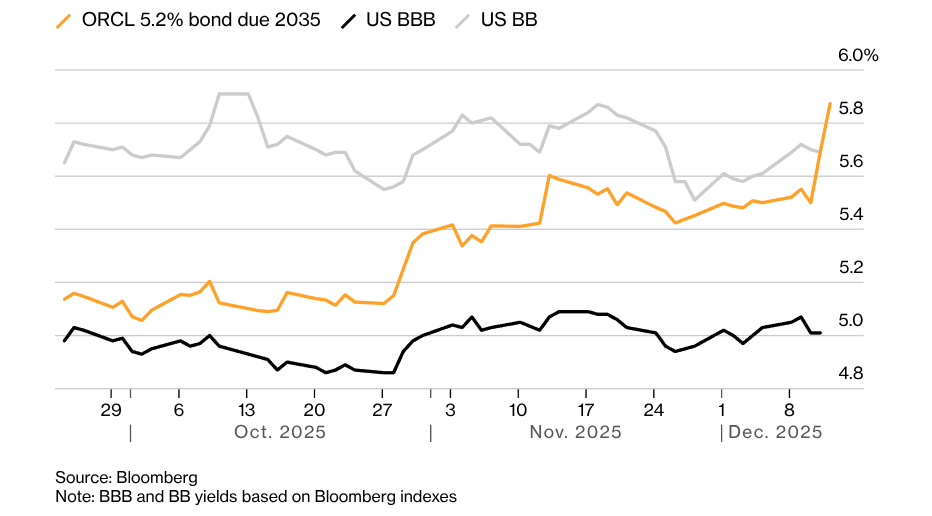
Bloomberg reports that Oracle debt now trades at junk-bond levels.
Jobs are the new prices:

Greg IP writes that with US unemployment up and wage growth down, jobs will soon replace prices as the focus of our economic anxiety.
Where the jobs are being lost:

Bloomberg reports that tariffs have hit small firms the hardest, causing them to shed jobs.
The good and bad news on tariffs:

A new study reports good news: Effective US tariff rates have so far been about half the headline number due to time lags, exceptions and enforcement gaps. The bad news, however, is that “nearly 100%” of tariffs are being passed through to consumers via higher prices.
Just getting started?

Joe Brusuelas reports that "The gap between US productivity and the hourly wage paid to non-supervisory employees continues to widen. If anything, the gap is accelerating as the American economy continues to be transformed by the global supply chain and technological advances."
Read on:

The FT reported earlier this year on the decline of reading: The percentage of Americans reading for personal interest is down 10 percentage points since 2005, although the percentage reading to children remains steady. Do newsletters count as personal interest? If so, please consider reading this one to a child.
Fewer kids to read to:

Torsten Slok notes that the percentage of US families with children has been falling.
The YouTube generation:

Nearly 50% of US teens say they “hardly ever” read in their spare time, up from 20% in 1990. Seems worrying, but you really can learn a lot on YouTube.
Land of the rising yield:
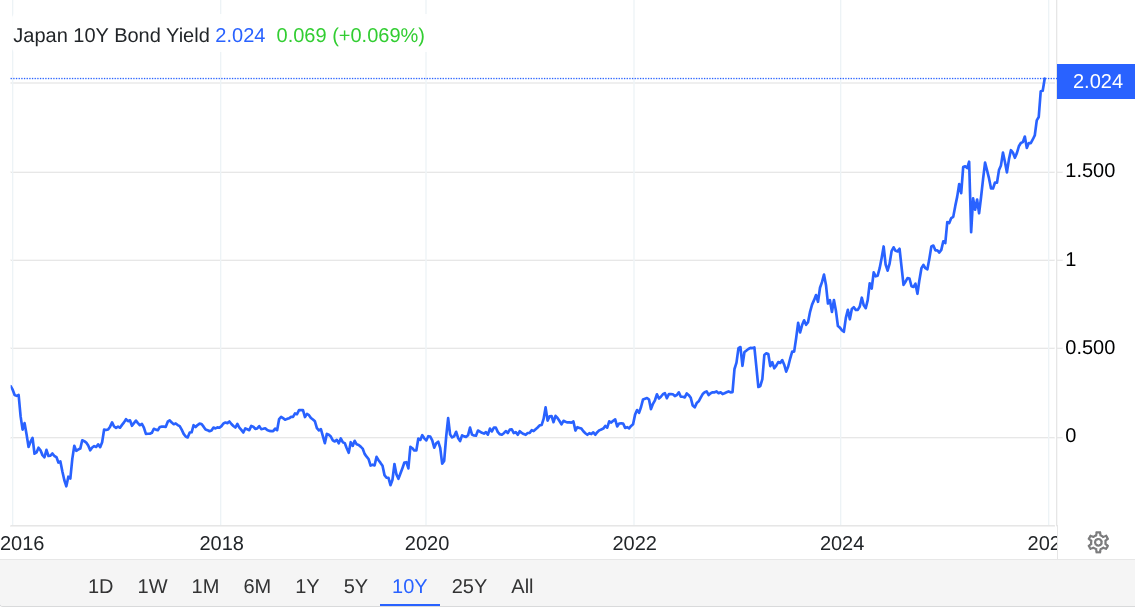
The yield on 10-year Japanese government bonds is about 2% for the first time since 1999. Higher yields typically mean Japanese savers will sell US investments to reinvest at home, but the opposite seems to be happening, likely because of the appeal of US AI stocks.
Prices by weight:

Measuring everything in price per pound, Andrew McCalip finds that a Tesla Model 3 costs less than Camembert. “We pull sand, oil, and ore from the earth and transmute them into machines cheaper than aged milk.”
Perhaps that is the kind of thinking we need to make sense of trillion-dollar valuations.
Have a great weekend, trillionaire readers.

Brought to you by:

Bittensor is building the open marketplace for AI.
Grayscale Bittensor Trust (GTAO) gives investors exposure to TAO — the network rewarding models for real intelligence.
Capture a part of the intersection of AI and crypto with GTAO.
Find GTAO in your brokerage account today.
GTAO is speculative, illiquid and entails a high level of risk, including the risk that an investor could lose their entire investment. GTAO is not suitable for any investor that cannot afford the loss of the entire investment. GTAO is distributed by Grayscale Securities, LLC.

Brought to you by:

Add onchain trading to your product without the hassle.
The Uniswap Trading API offers plug-and-play access to deep liquidity — powered by the same protocol that’s processed $3.3T+ in volume with zero hacks.
Get enterprise-grade execution across onchain and off-chain sources for optimal pricing. No complex integrations or crypto expertise — just seamless, scalable access to trusted DeFi infrastructure.
More liquidity. Less complexity.
