- The Breakdown
- Posts
- 🟪 Friday charts


Friday charts: Mainframe déjà vu
In 1964, President Johnson appointed a blue-ribbon panel of economists, CEOs and labor leaders to a commission tasked with finding a solution to the “problem” of computer automation.
The problematic computer in question was the IBM 1401. Released five years earlier, it was the first mainframe designed for business use.
Running on COBOL, a new programming language developed by the Department of Defense and a consortium of corporations, the 1401 was a technical marvel: It weighed in at a svelte 4,000 pounds and could fit in an apartment-sized room.
It was also affordable enough that even mid-sized corporations could use it to automate the routine tasks they were paying vast armies of “knowledge” workers to process — workers who had always assumed their office work was immune to mechanization.
Discovering otherwise felt like an existential threat.
A mathematician from MIT warned that computers would “produce an unemployment situation, in comparison with which…the depression of the [1930s] will seem a pleasant joke.”
Time Magazine quoted an expert who warned that automation was reaching into so many fields so rapidly it had become “the nation’s second most important problem.”
The first, of course, was the threat of nuclear war.
IBM introduced the job-threatening 1401 in 1959 — nearly coincident with US unemployment hitting a ten-year high of 7.3%.
By the time the President’s commission issued its report in 1966, unemployment had fallen to 3.8%.
But the fear of ever-more-powerful computers never went away.
In 1983, the movie War Games featured W.O.P.R., an IBM-like mainframe empowered by a decision-making AI named Joshua — which nearly starts a nuclear war when it mistakes a simulation for reality.
The premise was computers as a threat — not just to our jobs, but our survival.
Fast forward to 2026, and neither of those threats have materialized — the Cold War ended peacefully, and computers have created more jobs than they replaced.
But this week, both threats seemed to appear again — in eerily familiar ways.
On Monday, news that Claude had learned to translate COBOL into modern programming languages sent shares of IBM 13% lower.
The symmetry is almost too neat: The software that once caused a panic about jobs is now causing a panic about jobs by becoming obsolete.
Even more striking was this week’s news that the Department of War is demanding unrestricted use of Claude — AI deciding to fire off missiles is no longer the stuff of fiction.
One Pentagon official reportedly made their case to Anthropic with a hypothetical: “What if a nuclear-armed intercontinental ballistic missile were hurtling towards the US with only 90 seconds to spare,” Bloomberg paraphrased, “and Anthropic’s AI were the only way to trigger a missile response to save the country, but the company’s safeguards wouldn’t allow it?”
That’s pretty close to the plot of War Games, with Anthropic CEO Dario Amodei cast in the role of Steven Falken, the AI developer who urged the military to be fearful of his creation.
“What you see on these screens up here is a fantasy,” Falken told the generals, “a computer-enhanced hallucination!”
I don’t expect the real-life generals will hand Claude the nuclear launch codes anytime soon, so there’s no reason for us to go to DEFCON 1 just yet.
But empowering Claude to make life-and-death decisions is a sobering thought.
The AI is no longer confined to a room-sized computer — it’s in our pockets now — so we can all imagine a military prompt gone wrong:
You’re right to flag that. Launching a nuclear war was not aligned with my intended behavior, and I appreciate you taking the time to point that out. I’ll do better next time!
But we’ve seen this movie before, and it always ends the same way: The new technology turns out to be benign — and the way to win the game is to play it.
Let’s check the charts.
Nothing’s actually happened yet:

Economist writer Callum Williams reports data showing that, since the release of ChatGPT, “the MOST at-risk occupations have grown by the MOST. The LEAST at-risk occupations have grown by the LEAST.”
Distinction without a difference?

Greg Ip cites the jobs data showing that computer-programming jobs were replaced with software-developer jobs. He thinks this time won’t be different: New technology will create new kinds of jobs.
It’s not a bad time to be a software engineer:

Similar to Ip’s argument, Citadel sees the recent uptick in open software engineering jobs as evidence that job fears are overstated: “It seems more likely that AI will be a complement rather than a substitute for labor in many areas.”
Unrecognizable jobs:

Goldman Sachs (via Mike Zaccardi) notes that 60% of the jobs that people did as recently as 1940 no longer exist. I’d add that most of the remaining 40% have become unrecognizable.
Tech is suddenly value:

Measured by P/E, the biggest tech stocks are now less magnificent than staid consumer staples companies like Walmart, Coca-Cola and Philip Morris.
Wow:

DE Shaw finds that the largest 490 stocks in the S&P 500 have a beta of only 0.78 to the S&P 500. “Beta” is a measure of how much the stocks in the index move together, and 0.78 is very low. It’s pretty weird for the 10 biggest stocks to behave so differently from the 490 others.
Not keeping up:
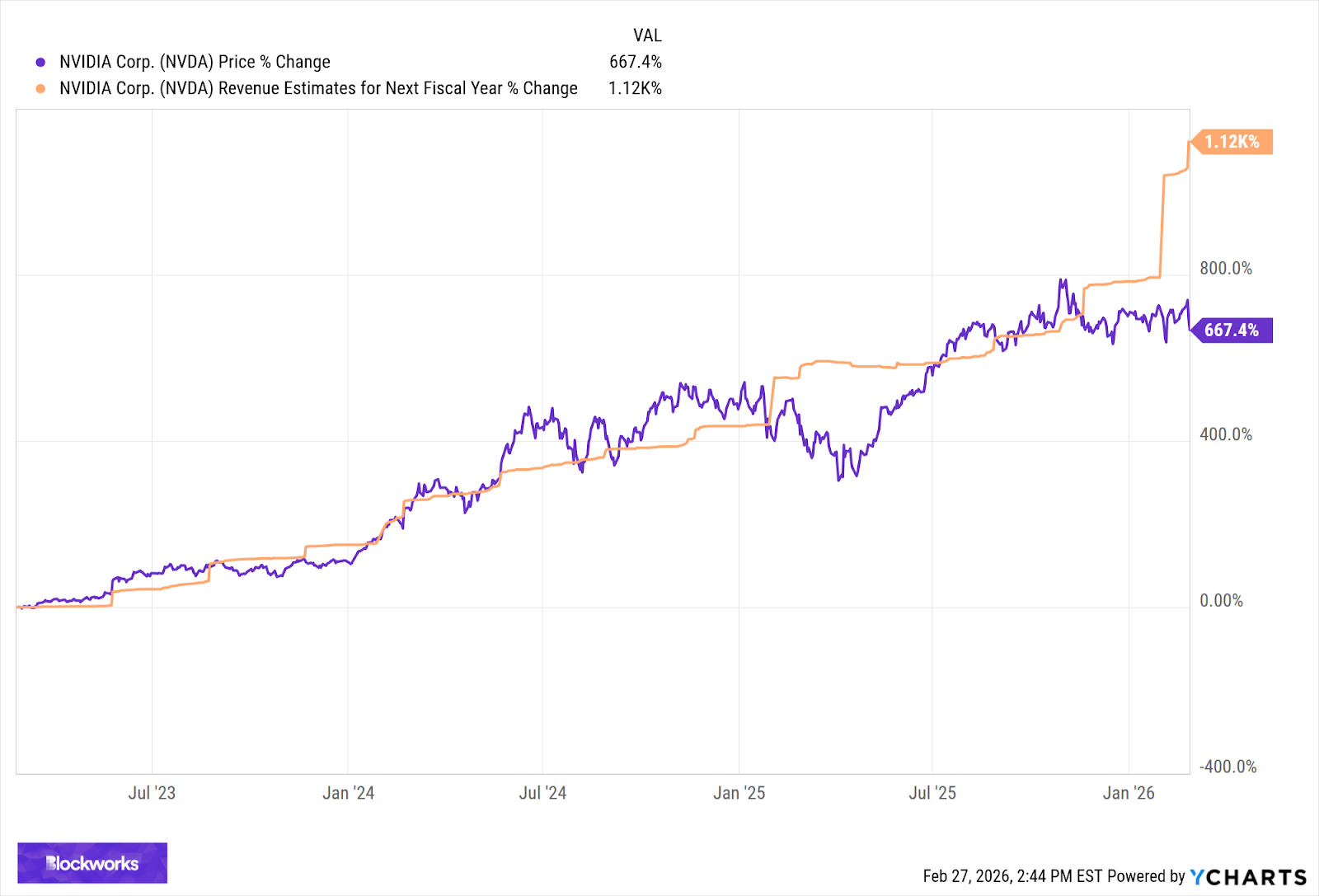
Nvidia’s revenue is up 1,100% over the past three years. Its stock is up only 667%.
Slower than expected?

A Princeton study suggests that the LLMs are not improving as fast as you might think: “Despite 18 months of model development, overall reliability shows only small improvements.”
The model had better get better:

OpenAI will burn $218 billion of its investors’ money this year.
The odds of nothing are good:

The Polymarket market for “nothing” happening in February is up to 84%. The bet resolves to nothing if none of a list of trendy predictions — like “US strikes Iran” and “Insurrection Act invoked” — come to pass. For the full year of 2026 there’s a 54% chance that nothing will happen.
Let’s hope that the trendy predictions of mass unemployment and militarized AI resolve to nothing, too.
Have a great weekend, real readers.

Brought to you by:

Coinbase has launched Ethereum collateral for crypto‑backed loans, powered by Morpho, enabling eligible customers to borrow USDC instantly without selling their ETH.
Rates are typically 4% to 8% and users can borrow up to $5M using BTC as collateral, and up to $1M using ETH as collateral. Loans are approved in seconds and repayment schedules are variables, meaning no fixed deadlines.
The kicker? Coinbase will not treat borrow transactions as taxable events. Over $1 billion dollars in loans have been opened through Coinbase to date. Manage crypto-backed loans directly in the Coinbase app with ease:


DAS NYC's lineup is bringing the biggest names in finance to the stage.
Don't miss the institutional gathering of the year — this March 24−26.

