- The Breakdown
- Posts
- 🟪 Friday Charts




Friday charts: Dōmo arigatō, Mr. Roboto
Cognitive scientist Stevan Harnad believed the Turing Test was an insufficient measure of AGI. A machine that sounds like a human, he thought, was only displaying mimicry, not a sign of intelligence.
So he raised the bar. AGI would only be achieved, he said in 1991, when a machine could pass the Total Turing Test: “The candidate must be able to do, in the real world of objects and people, everything that real people can do.”
In other words, an intelligent, all-purpose robot.
It was a fanciful notion at a time when the original Turing Test was still the stuff of science fiction.
Now, however, chatbots that can perfectly mimic humans are a matter of course. LLMs like ChatGPT and Claude have blown past the Turing Test. And Harnad was right — it’s not that big of a deal.
But what if we blow past the Total Turing Test, too? Will that be the AGI moment that changes everything?
We might soon find out, because the robots are getting really, really good.
Last month, for example, a table-tennis playing robot was hailed as the first machine to achieve expert-level performance in a competitive, physical sport.
That’s the only thing that particular robot can do, so it doesn't pass the Total Turing Test. But it still feels like the crossing of a Rubicon. If robots can play table tennis, what can they not do?
Maybe nothing. We already have robot scientists, airport workers, tomato pickers; robots working in search-and-rescue robots and elder care; and robots that can make your bed (slowly) and do the dishes.
There’s even a robot monk now. Is no job safe???
Maybe not, because robots built in the form of humans — and empowered by AI — can seemingly do anything we can.
The South Korean automaker Hyundai, for example, plans to employ humanoid robots in a factory in the US by 2028. Real humans will still be needed to maintain and train the robots, a Hyundai executive said. But how long will it be until the robots can do that, too?
Already, the robots are starting to make the robots.
So you can see why Elon Musk says that, in the not-too-distant future, “probably none of us will have a job.”
That is a scary prospect, of course. What will we do all day, if not go to work? Will the robots support us, as depicted on the New Yorker cover? Or will they have no use for us, as in dystopian sci-fi like WALL-E? Or — scariest of all — view us as a threat, as in The Terminator?
The reassuring thing is that people have been worried about this — wrongly! — for at least a hundred years now.
In 1928, the New York Times warned that the rudimentary automation technology of the time was responsible for rising unemployment.

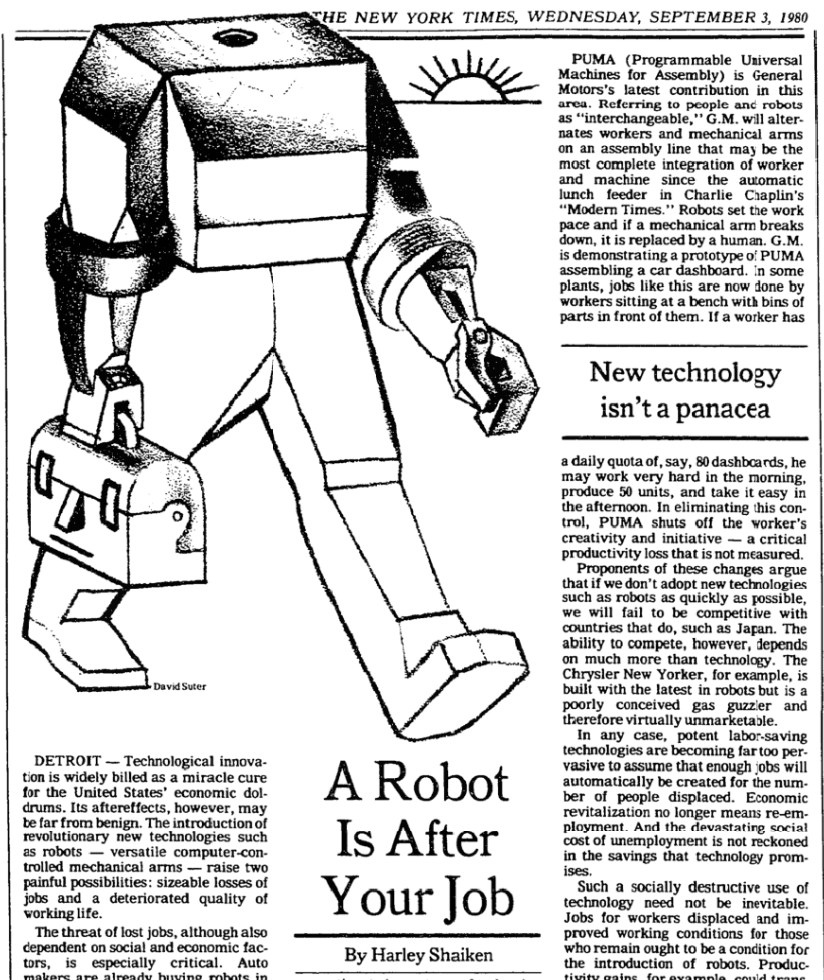
In 1980, the same paper warned that “a robot is after your job”:
In 1995, Jeremy Rifkin’s The End of Work became a bestseller. (Unemployment was in the process of falling from 7.6% at the start of the decade to 3.9% at the end.)
In 2015, Gartner predicted that automation would eliminate a third of all jobs by no later than 2025. (It’s 2026 and there are now more jobs, not less).
In 2017 — with ChatGPT still five years away — a New Yorker cover perfectly captured the latest incarnation of automation angst:

Now, in 2026, the robots really are here — but this may be less worrying than ever.
It’s no accident that both Hyundai and the robot monk are South Korean. At current birth rates, for every 100 South Koreans alive today, it’s estimated there will be fewer than seven great-grandchildren.
That doesn’t seem like enough new humans to keep a country’s physical infrastructure, manufacturing base, and government services from falling into disrepair.
Which means robots will have to do the job.
Much of the world will soon have the same problem. In China, the working-age population is expected to fall by two-thirds by the end of the century. Europe and the US are headed in the same direction.
It’s possible that robots will be doing literally all the jobs by then. But that still feels like science fiction to me — especially now with fewer and fewer humans willing to do things like pick tomatoes, care for the elderly, and lead us in prayer.
To paraphrase Asimov: the real worry may not be too many robots, but too few of them.
Let’s check the charts.
Man vs. machine:

At the current price of tokens, AI coders are far cheaper to employ than human ones. But for call centers and data entry, human labor remains competitive.
Agents getting more expensive:

We’re accustomed to the cost of new technologies rapidly falling. But the “LLM Token Expenditure Index” shows that the market is paying more, on average, per token of AI compute as usage shifts toward newer, more expensive frontier models. That will be worth it for some tasks, like coding. For other tasks, like call centers, it won’t be.

Goldman Sachs estimates that token consumption will rise 24 times by 2030. They’re probably not going to get cheaper, if so — especially if plans for new data centers keep getting cancelled.
Does AI create jobs?

A study reaches the counterintuitive conclusion that “occupations with higher exposure to AI have grown faster than the least-exposed ones, not slower.”
Where AI creates jobs:
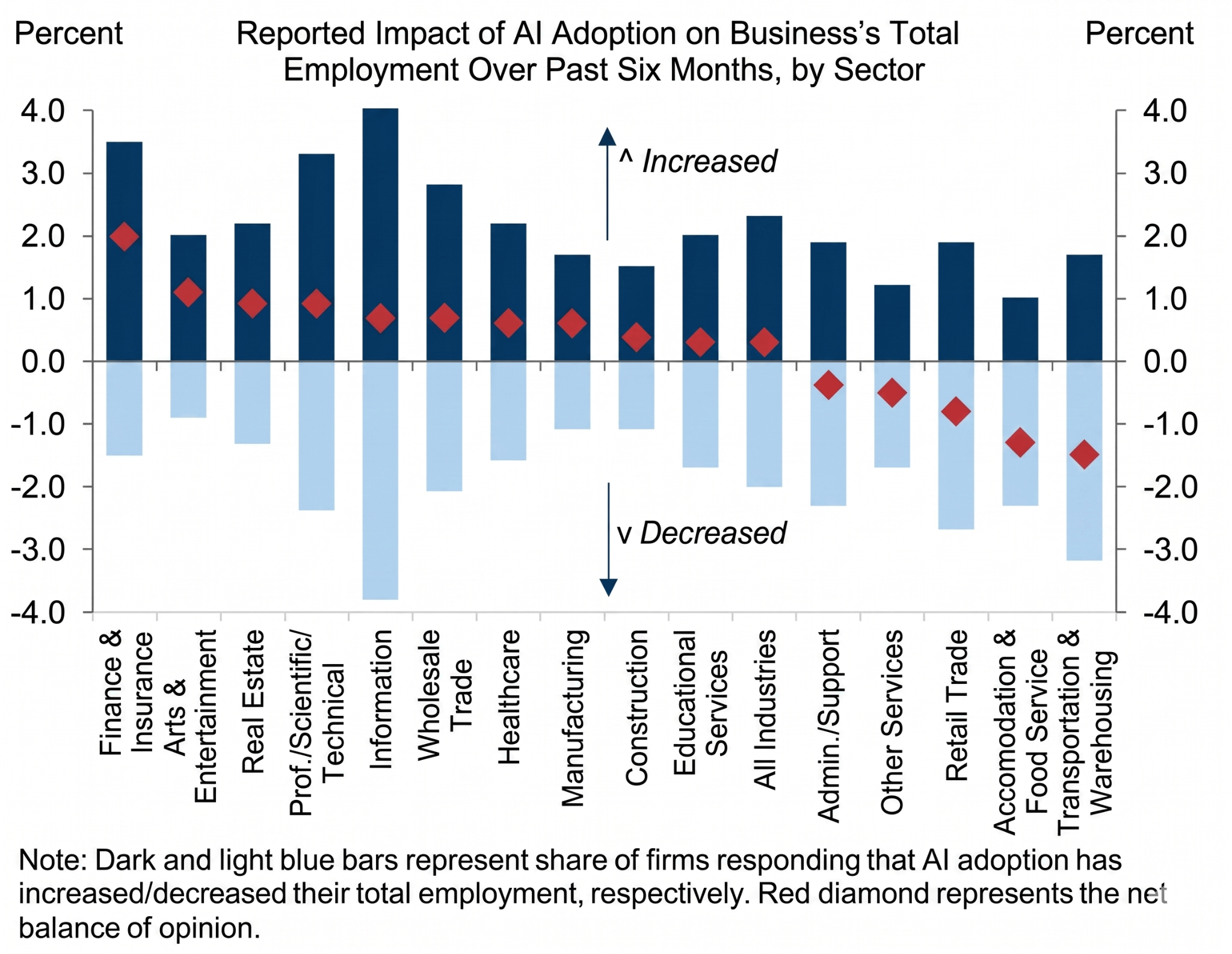
A Goldman Sachs survey finds that, in a majority of industries, companies say AI is increasing headcount.
Software devs, too?
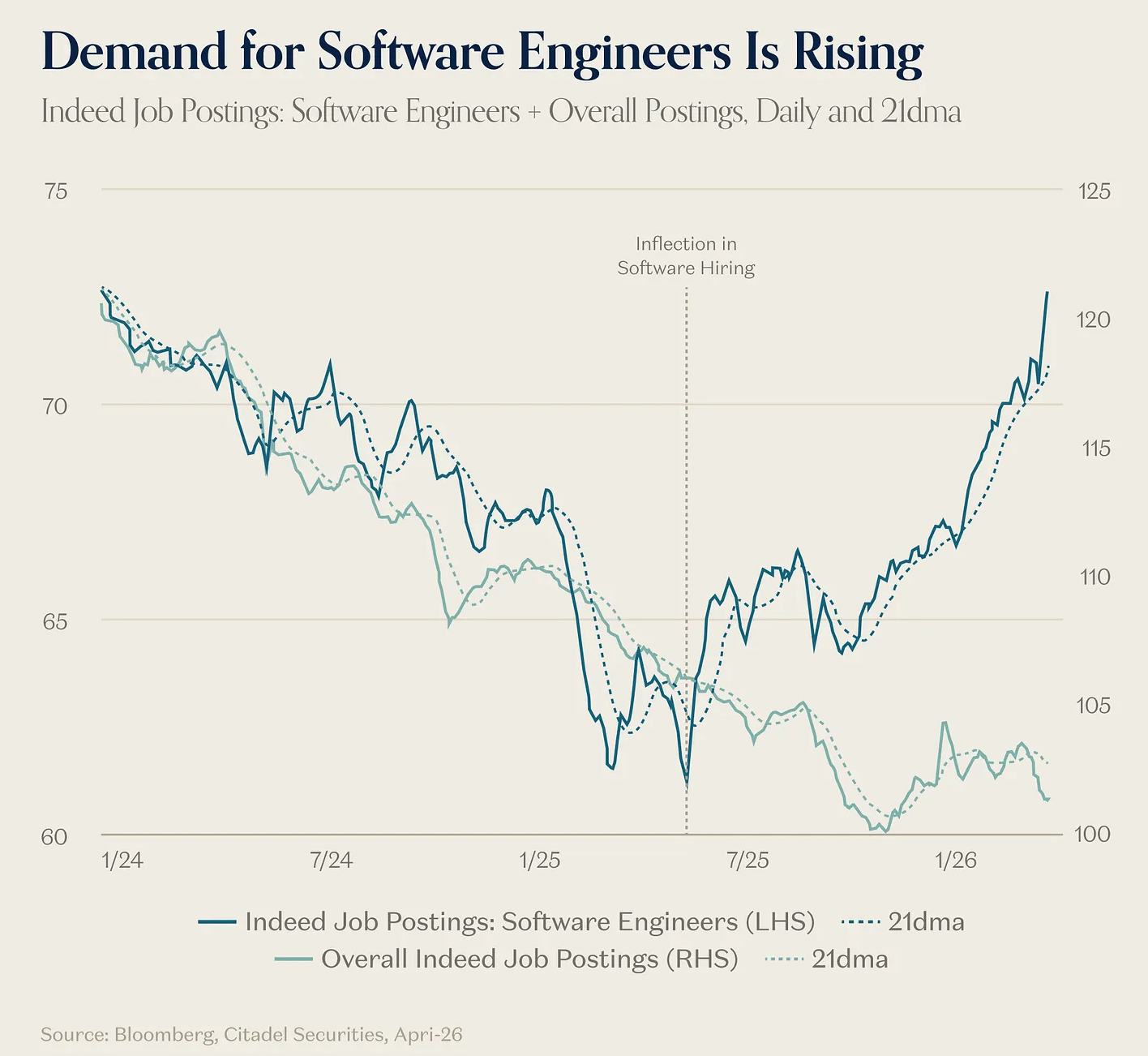
A16z notes that, based on data from Indeed, demand for (human) software developers seems to be rising, while overall demand for employees seems to be falling. This is recovering off of a low base, however.
Mythos really is good at coding:

Mozilla reports that Mythos helped them find and fix 423 bugs in the month of April — 20x more than the recent average.
Robots needed:

In 2016, Geoffrey Hinton — the “godfather of AI” — warned medical school students not to become radiologists, because they’d be the first to be replaced by AI. Radiologist incomes have been booming ever since.
Cause and effect?

It’s true that recent college graduates are having a harder time finding jobs than other age cohorts. But Callum Williams notes that the shift started well before the release of ChatGPT, so AI may not be the cause.
Trade schools are booming:

Seeking a safe haven from AI, young people are going into the trades again. Community college programs are full-up, so people are paying private-school tuition and taking on debt to learn things like auto repair.
AI authors:
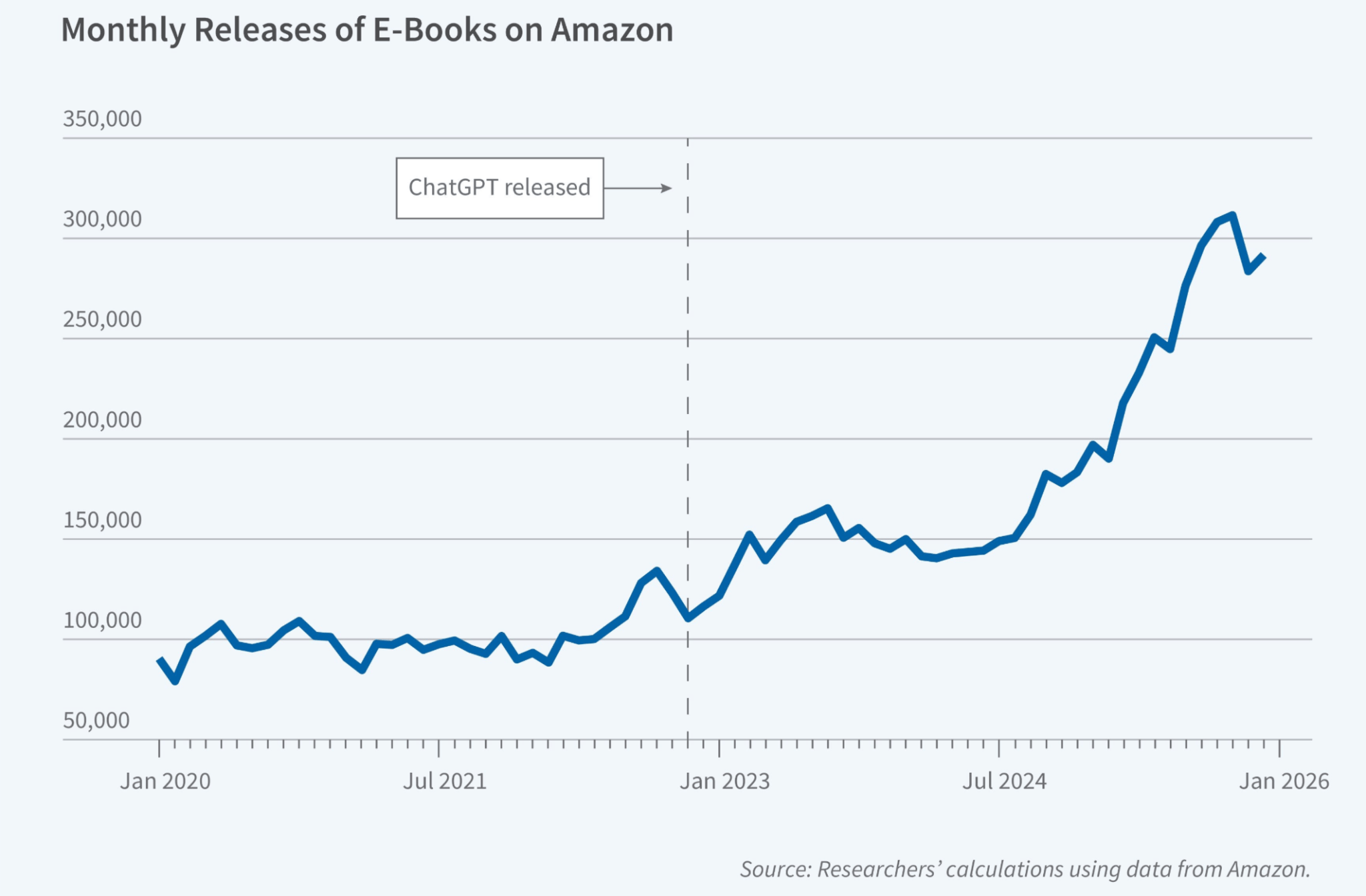
The release of e-books has roughly tripled since the introduction of ChatGPT. I’ve tried a few AI-authored books and they are terrible. But maybe the robots will like them?
The population bomb:

The number of Chinese working-age adults is projected to shrink by two-thirds by the end of the century. That should leave a lot of work for the robots to do.
Or older people:

Data from the Economist shows that more and more South Koreans are staying in the workforce longer — probably because there are fewer and fewer workers to replace them.
Have a great weekend, humanoid readers.