- The Breakdown
- Posts
- 🟪 Friday charts


Friday charts: Apocaloptimism
The trailer for The AI Doc, in theaters today, compiles some of the direst warnings on AI. Doomer Eliezer Yudkowsky, for example, predicts AI will lead to the “abrupt extermination of society.” Another expert says he knows researchers working on AI risk “who don’t expect their children to make it to high school.”
The CEO of Anthropic, Dario Amodei, is also prominently featured: “Am I confident it will go right?” he says of the product he’s building. “Absolutely not.” He believes AI will eliminate 50% of entry-level jobs in fields like technology, finance and law.
But these warnings seem to be losing their shock value — perhaps because we’ve been hearing them for some time now, and not much has happened as of yet.
For example, it’s been 54 weeks since Amodei predicted that AI would be writing 100% of code “in about a year.” But people still write code. Also, Yudkowsky once warned that nanotechnology would result in human extinction “no later than 2010.” It’s 2026.
This week in particular, it felt like the tide is turning against AI doomerism.
Andrej Karpathy, the computer scientist who coined the term “vibecoding,” conceded that AI is not so good at writing code: “I’m not very happy with the code quality,” he wrote on X. No matter how many times he specifies what he wants, “the agents do not listen to my instructions.”
On the risk to jobs, Anthropic co-founder Jack Clark said on a podcast this morning that AI “doesn’t replace people.” Instead, it “changes the sort of work that people do.” (In a good way, he means.)
On the panic in software stocks, LinkedIn founder Reid Hoffman dismissed the idea that everyone will write their own software as “a distinct flavor of foolishness.” Hoffman adds that “Jevons’ Paradox will do what it always does” — as software gets cheaper, people will use disproportionately more of it.
That should mean more work for software engineers, not less. (A recent HBR study seems to confirm this intuition.)
Also this week, Walter Isaacson noted that “AI has created about 1.2 million new jobs over the last two years.” He expects that to continue: “It’s going to create more jobs than it destroys.”
All this seems inconsistent with the predictions of imminent doom. If AI can’t put software engineers out of work, it probably cannot exterminate humanity either.
The market remains concerned, however. Software stocks fell sharply today on reports that the next Claude model — ominously named “Mythos” — will be a “step change” in AI (and is particularly adept at cyberhacking).
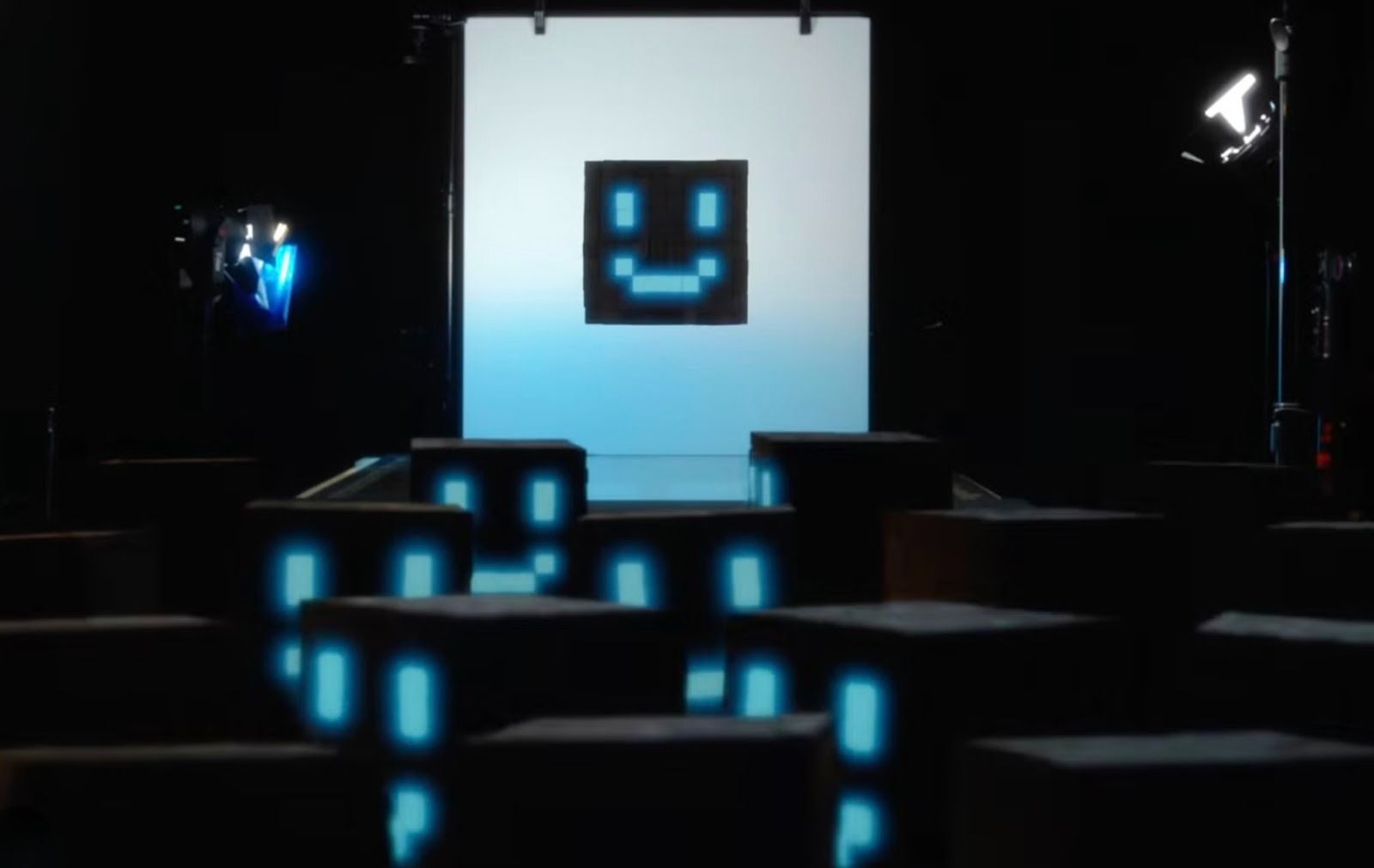
So maybe we all need to go see a movie. The full title of the documentary out today is The AI Doc: Or How I Became an Apocaloptimist.
After giving the doomers their say, the trailer introduces AI optimists like Peter Diamandis, who believes AI is “a massive opportunity for humanity, not a threat.”
Perhaps most encouraging, The AI Doc features an optimist from Anthropic, too: Dario Amodei’s sister, Daniela Amodei.
Daniela, President and co-founder of Anthropic, disagrees with her brother on the risk to jobs: “Humans plus AI together actually create more meaningful work,” she says — “more challenging work, more interesting work, high-productivity jobs.”
She also disagrees with Yudkowsky on the risk to humanity: “The things that make us human will become much more important instead of much less important.”
I believe that makes her an Apocaloptimist: AI will be as powerful as her brother fears. And humans will be all the better for it.
Let’s check the charts.
Doing more with more:
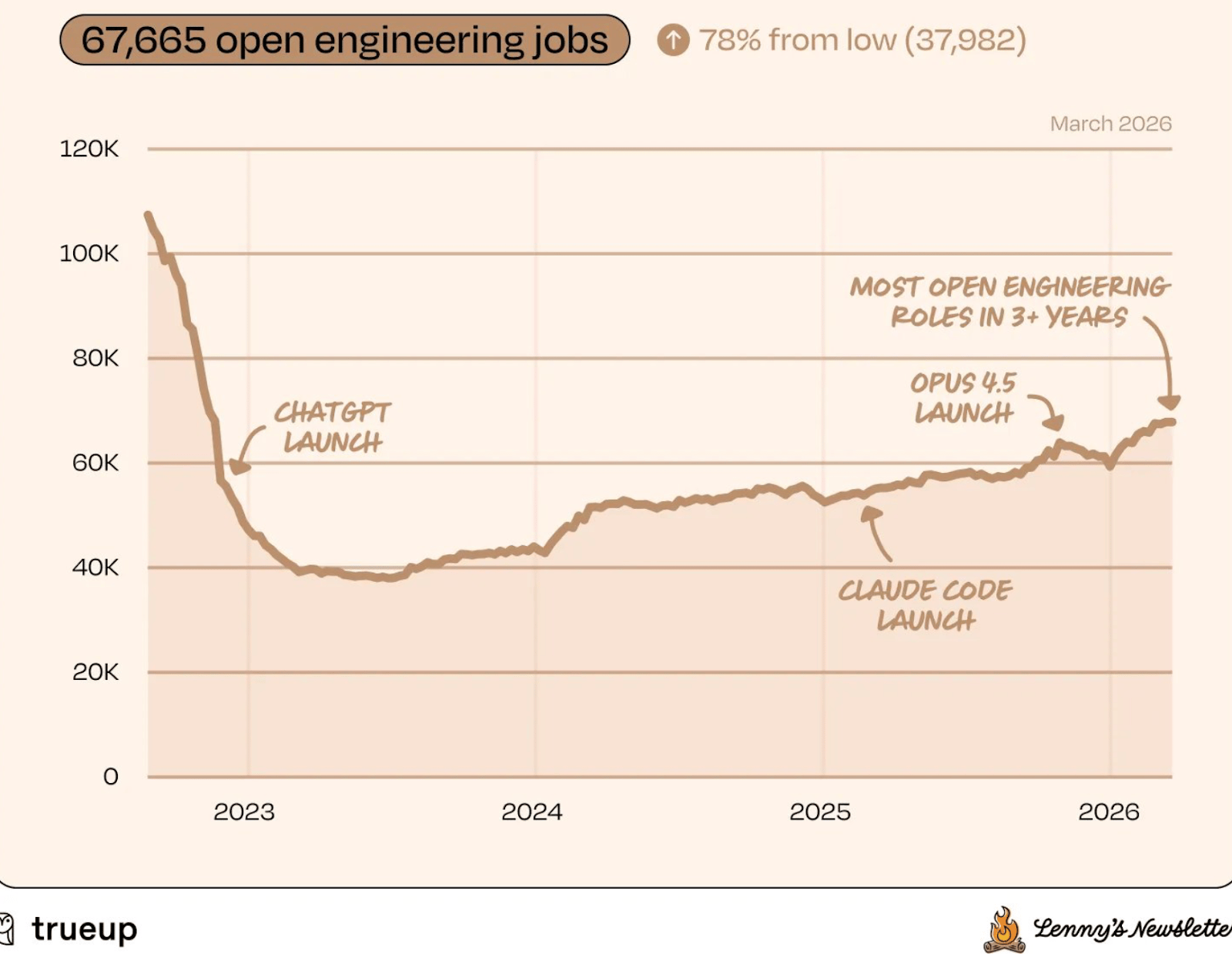
TrueUp estimates that openings for software engineering jobs in the US are up 78% from the lows they hit shortly after ChatGPT launched.
You say tomato…
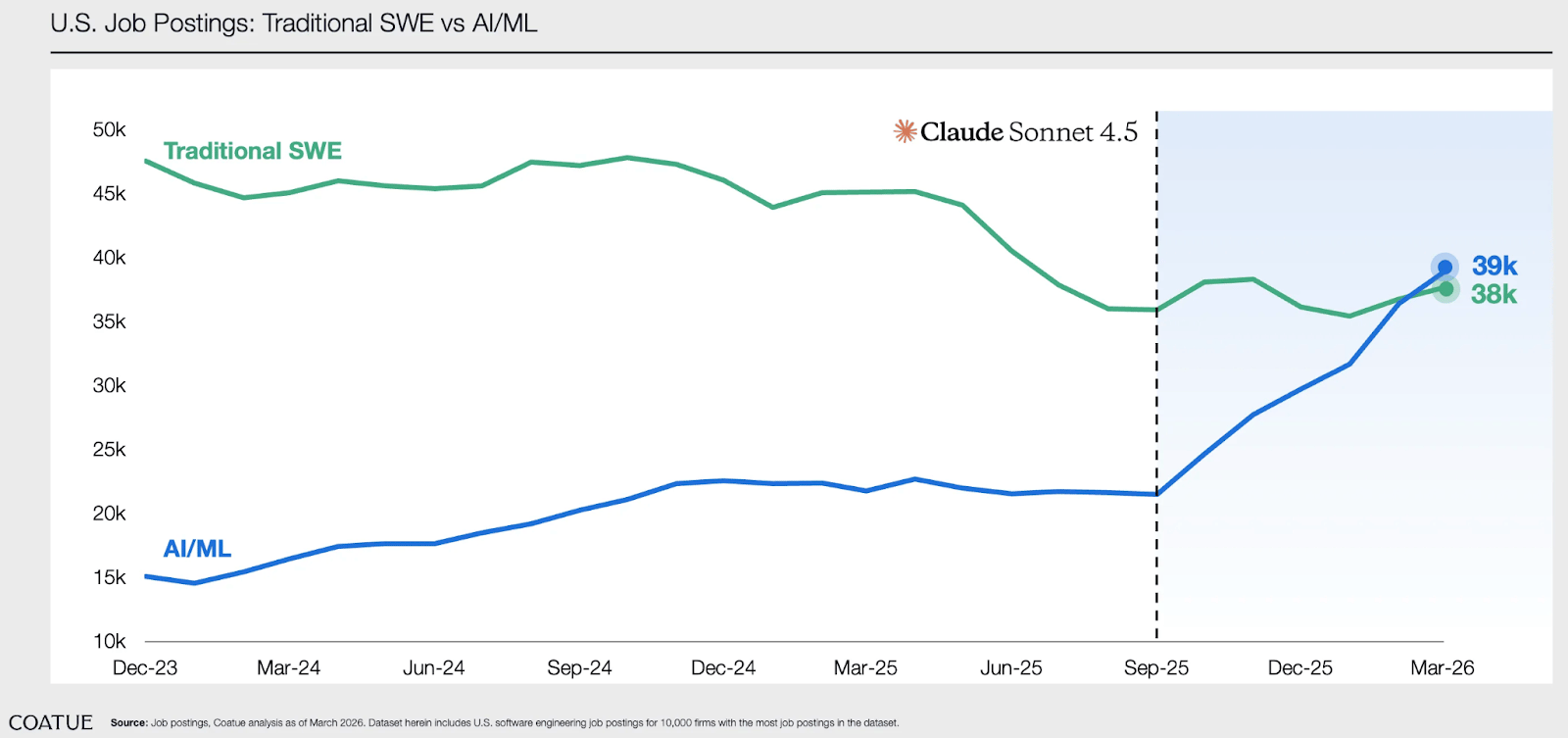
Coatue notes that software-engineering jobs are down, but AI-engineering jobs are up. “It feels like a hiring reallocation, not a cycle.”
Fundamentals up, valuation down:
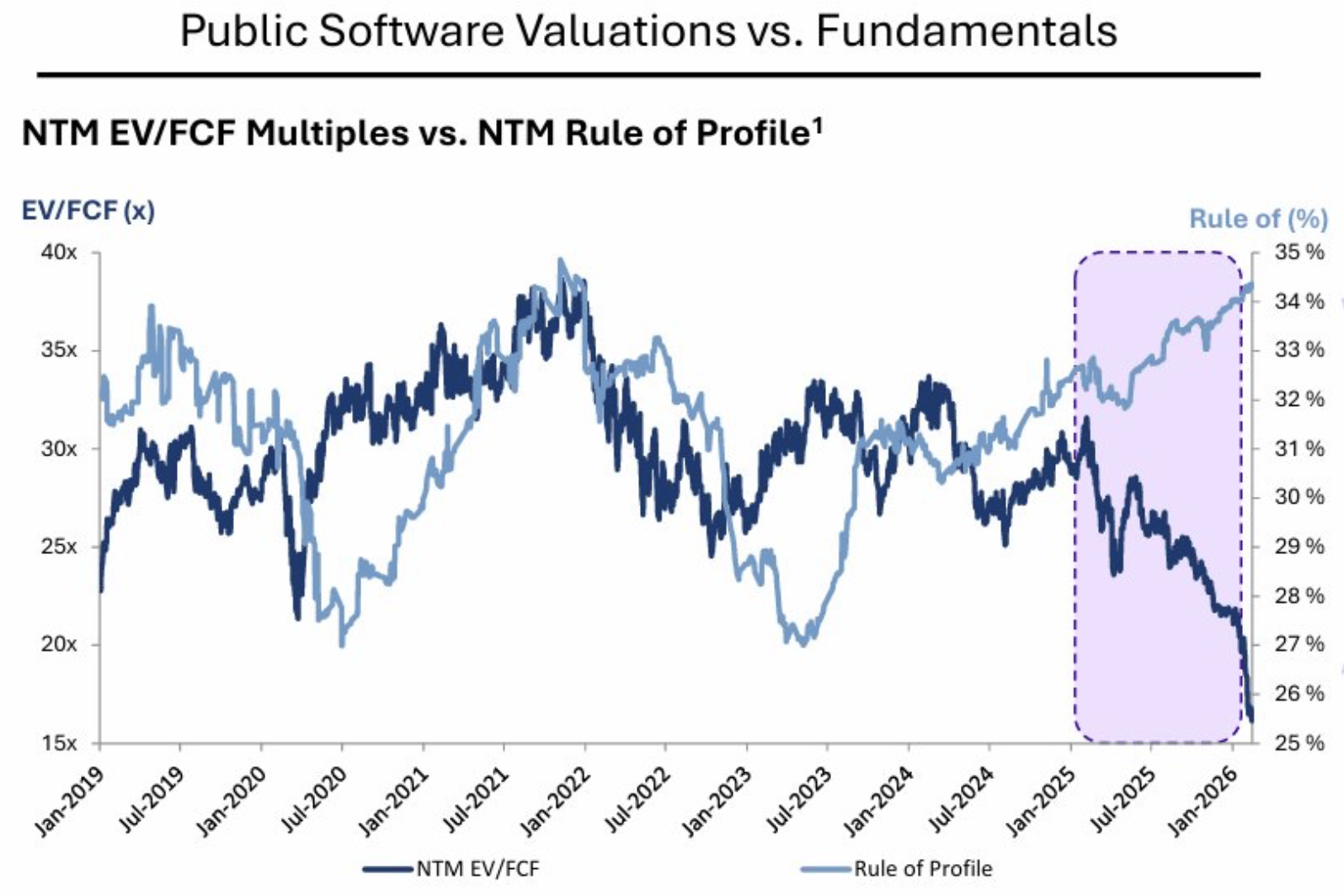
The software investors at Thoma Bravo find that the valuation of software stocks (in dark blue) has decoupled from a measure of software-company fundamentals (FCF margin + revenue growth, in light blue). They think this “dislocation” is creating an opportunity.
Lots of dislocating right now:
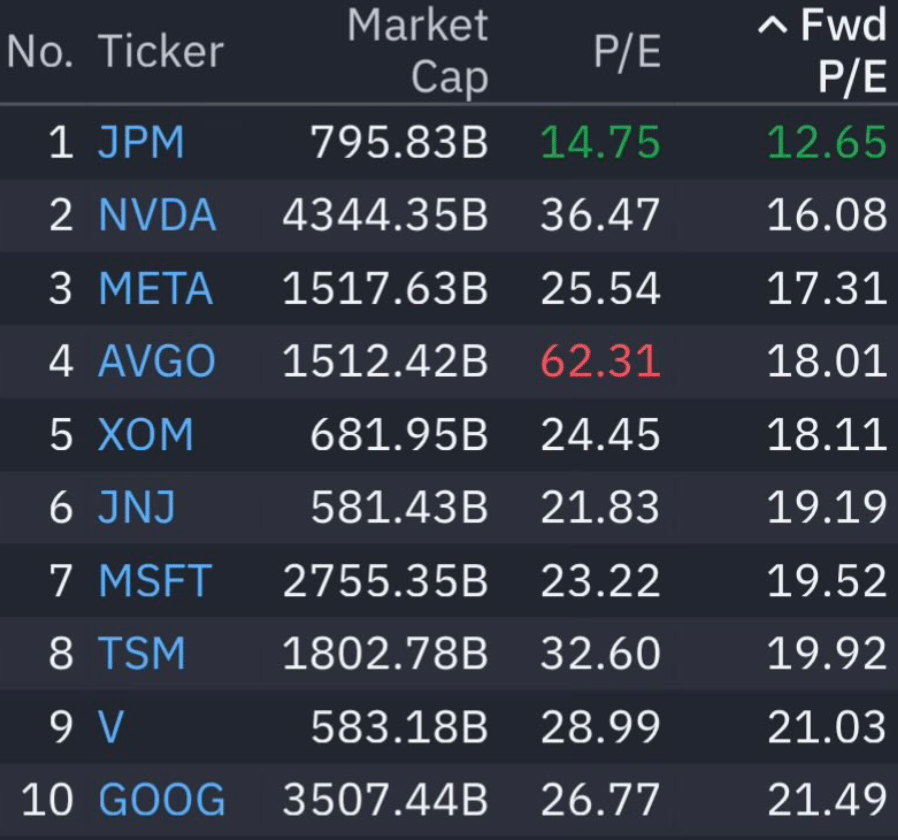
@Mr_Derivatives notes that all of the biggest stocks in the S&P 500 are far cheaper on forward estimates. Unless you think forward estimates are very wrong, stocks are getting unusually cheap.
Services-as-software:
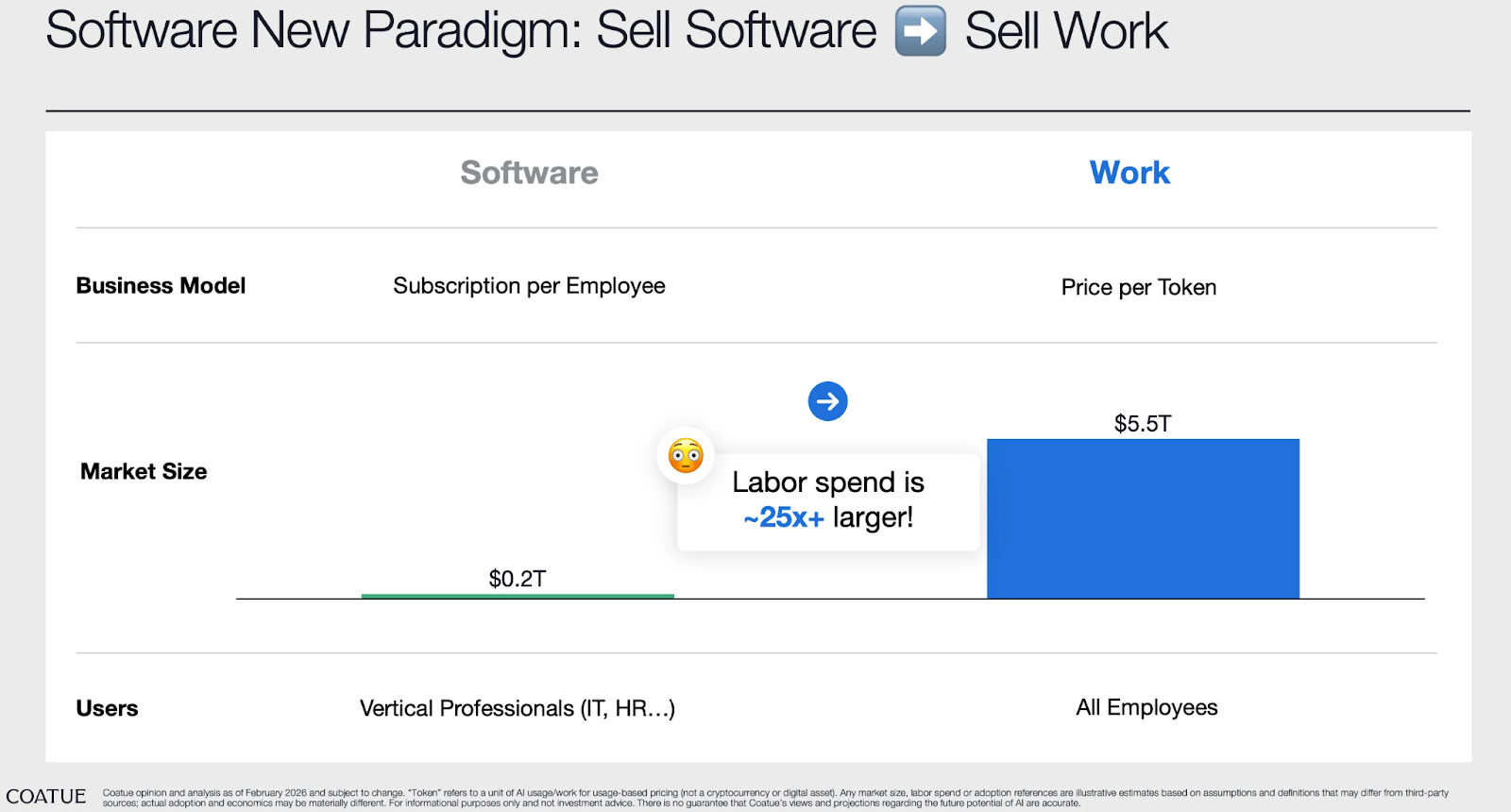
Coatue coins a new term (still SaaS, but reversed) to make the bull case for software stocks. “By shifting the unit of value from the tool to the results, the addressable market potential expands by 25x. We are moving from a $0.2T software market to a $5.5T ‘services-as-software’ paradigm.”
Ramping revenue:
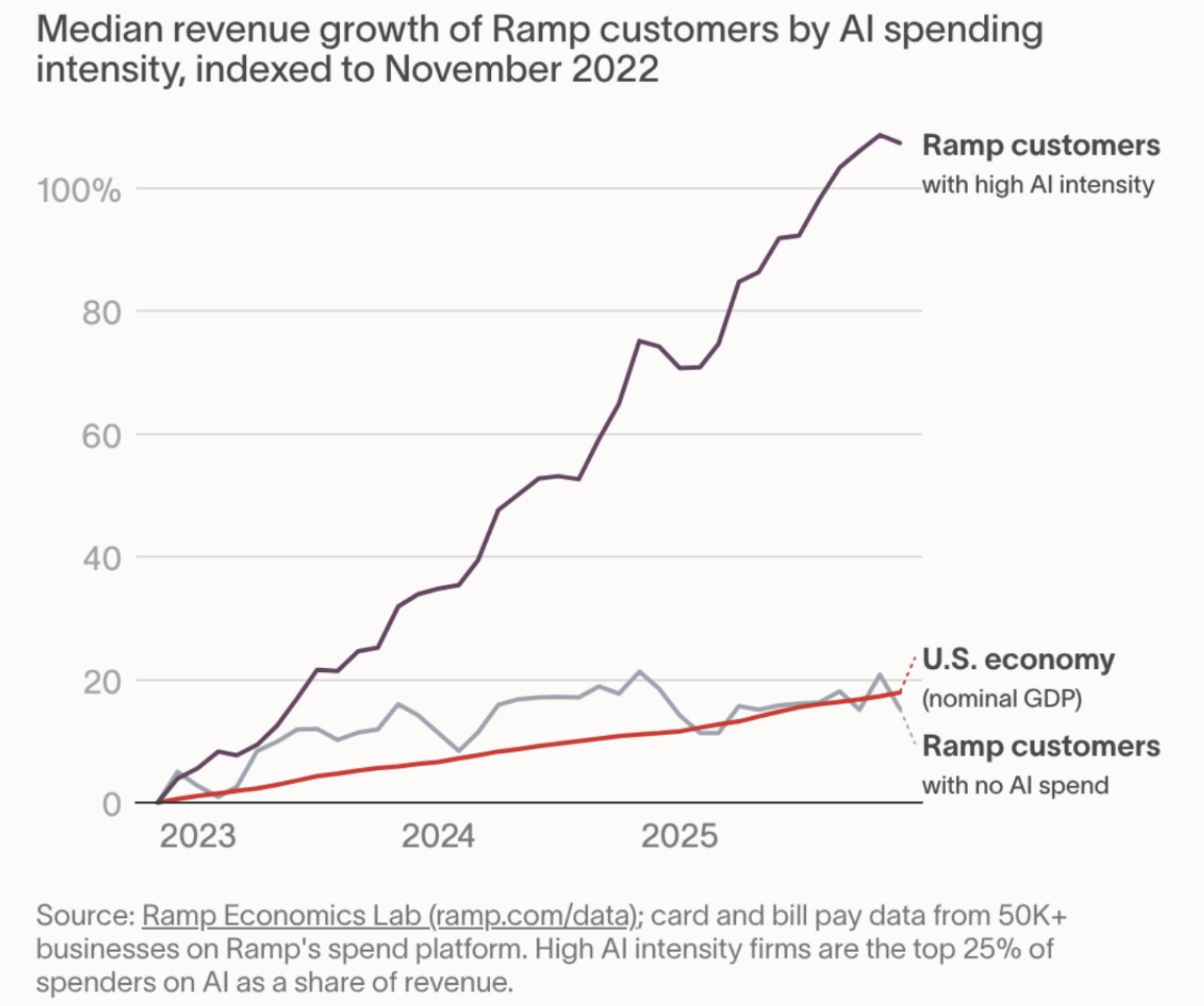
Data from Ramp shows that “the top quartile of AI spenders on our platform has more than doubled their revenue, while the bottom quartile has been essentially flat.” I’m skeptical of the causality there, but it’s a good chart either way.
Anthropic’s “IPO”:
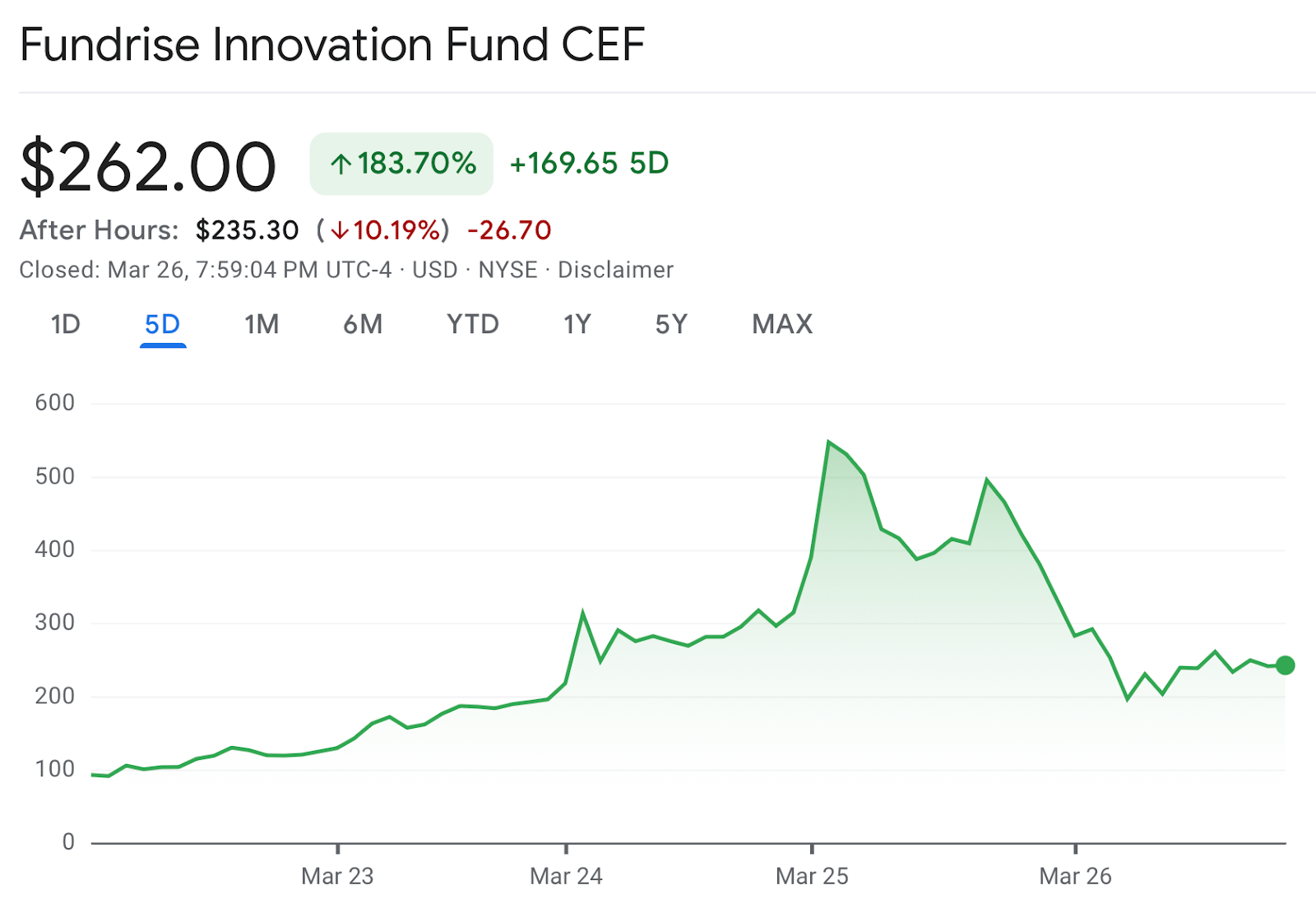
Josh Kale notes that a closed-end fund whose top holding is Anthropic shares (which are otherwise unlisted) trades as high as $550 this week — vs. a NAV of just $19. Anthropic is reportedly planning to IPO for real in the fourth quarter of this year.
GPU rental rates rising:
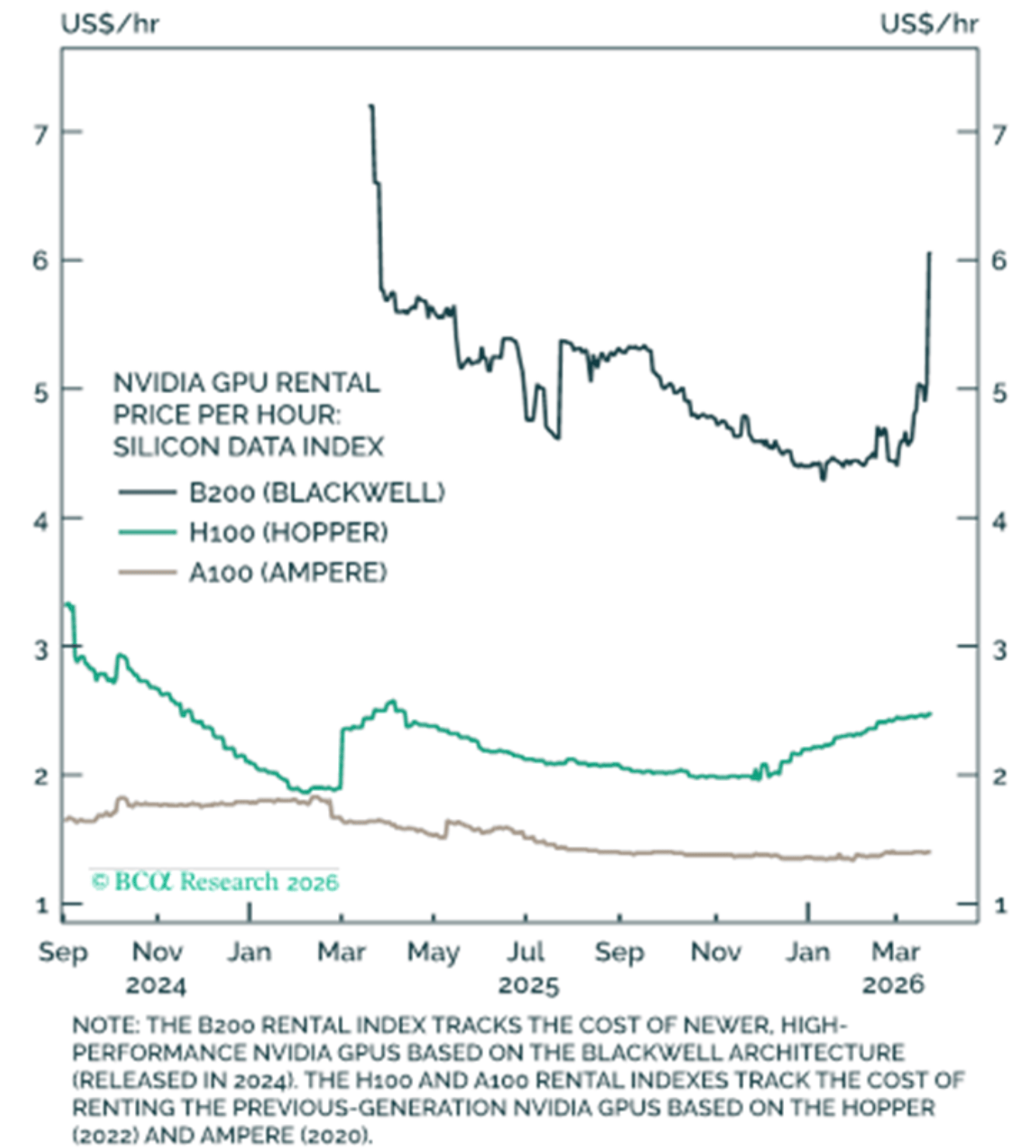
BCA reports that the cost of renting a Nvidia Blackwell GPU has shot higher, presumably because AI agents are so good at burning tokens.
One non-AI risk:
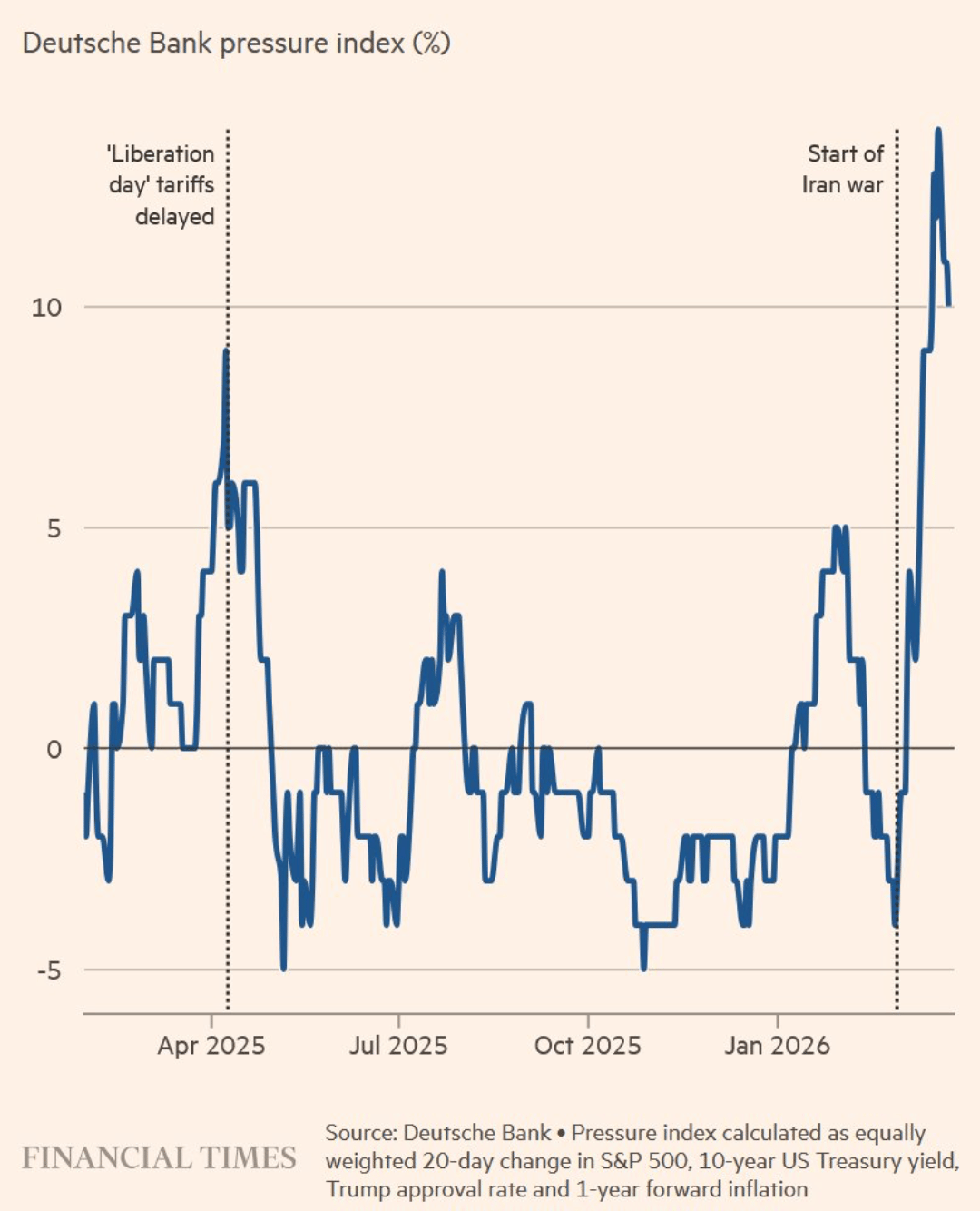
Deutsche Bank created an index measuring how much pressure President Trump is under to change course. Based on changes in approval rating, inflation expectations, and asset prices, the index suggests it may soon be TACO time.
The truth is, no one really knows what the risks from AI will be. But there are many reasons for optimism, including some fundamental ones.
Dean Ball, for example, notes that AIs are trained on the internet, which limits how good they can get: Anyone who thinks “all the world’s knowledge” is on the internet is deeply mistaken.
There will always be things we know and the AIs don’t. We only have to go find those things.
Have a great weekend, Apocaloptimist readers.

Brought to you by:

US Treasuries are the lifeblood of our financial system, providing collateral to support transactions, but outdated legacy systems hinder collateral mobility.
A new white paper from the ValueExchange dives into the future of collateral mobility, RWA tokenization, and what we can learn from a recent series of on-chain repo transactions conducted on Canton, the only public blockchain built for institutional finance.
With over $8T tokenized transactions flowing on Canton every month, including over $350B of on-chain US Treasuries moving daily, Canton is building the scalable, always-on capital markets infrastructure of the future.

Introducing Blockworks Investor Relations, an IR platform built for onchain businesses.
The latest Blockworks offering brings together analytics, a branded investor relations site, and integrated advisory support into a single platform. The result is a more efficient way to share your story, build trust with investors, and engage a global audience from day one.
If you’re building in crypto and want to upgrade your investor relations function, we’d love to work with you. Book a meeting with the Blockworks team to get started.