- The Breakdown
- Posts
- 🟪 Friday paradoxical charts


“It is a confusion of ideas to suppose that the economical use of fuel is equivalent to diminished consumption. The very contrary is the truth.”
— William Jevons (1865)

Friday paradoxical charts
Marc Andreessen called this week’s release of the R1 chatbot from DeepSeek a “Sputnik moment” for AI.
Mark Zuckerberg immediately convened four “war rooms” of Meta engineers to catch up with DeepSeek’s efficiency innovations.
And President Trump called it a “wake-up call” for the US tech industry.
I thought it was great news.
In part, that’s because AI researcher Yann LeCunn says the DeepSeek news is not about China surpassing the US, but about open-source models surpassing proprietary ones (to everyone’s benefit).
But mostly it’s because MIT’s Olivier Blanchard called it “the largest positive one-day change in the present discounted value of total factor productivity growth in the history of the world.”
That’s not quite as snappy as the negative takes, but positive takes rarely are.
If DeepSeek represents a radical advance in “total factor productivity,” however, it could come to be remembered as a large step in the direction of the “consumer cornucopia” envisioned by Marc Andreessen, in which AI will make “everything you need and want [available] for pennies.”
That happy development won’t come without risk for investors, however.
Greg Jensen of Bridgewater expects the market will soon have a “Barnes & Noble moment” in which AI becomes an existential threat to incumbent, non-tech businesses in the same way that Amazon was to brick-and-mortar booksellers in the 1990s.
More immediately, investors worried this week that DeepSeek’s efficiency breakthroughs will result in less demand for both GPUs from Nvidia and cloud services from Nvidia’s biggest customers.
These have been the two pillars of stock market returns in recent years, so it’s understandable that investors are concerned.
The pillars themselves seem not at all concerned: Meta and Microsoft both reiterated their intention to spend tens of billions of dollars on AI infrastructure this year.
The news from DeepSeek might even accelerate those investments.
Microsoft’s Satya Nadella predicted this week that as “AI becomes more efficient and accessible, we will see exponentially more demand."
DeepSeek’s innovations have already made AI more efficient and accessible and that might result in more demand for Nvidia GPUs and cloud computing services — not less demand, as the market fretted about this week.
This would be Jevons paradox in action — when the more efficient use of a resource leads to even higher consumption of that resource.
Nadella invoked Jevons paradox in response to the DeepSeek news this week, and he should know — in the 2010s, when cloud computing was as nascent as AI is now, cloud costs fell by as much as 25% a year while revenue at cloud providers (like Microsoft) rose by as much as 70% a year.
A similar pattern in AI compute would be a great outcome for both investors and the world — hopefully.
Jevons paradox only applies if the cost of a resource is a limiting factor in its usage, and we don’t yet know if that’s the case with AI.
If you believe it will be, then this week’s selloff in shares of NVDA and Microsoft are likely buying opportunities — if you don’t, they’re not.
Let’s check the charts while we wait to find out.
DeepSeek downloads:
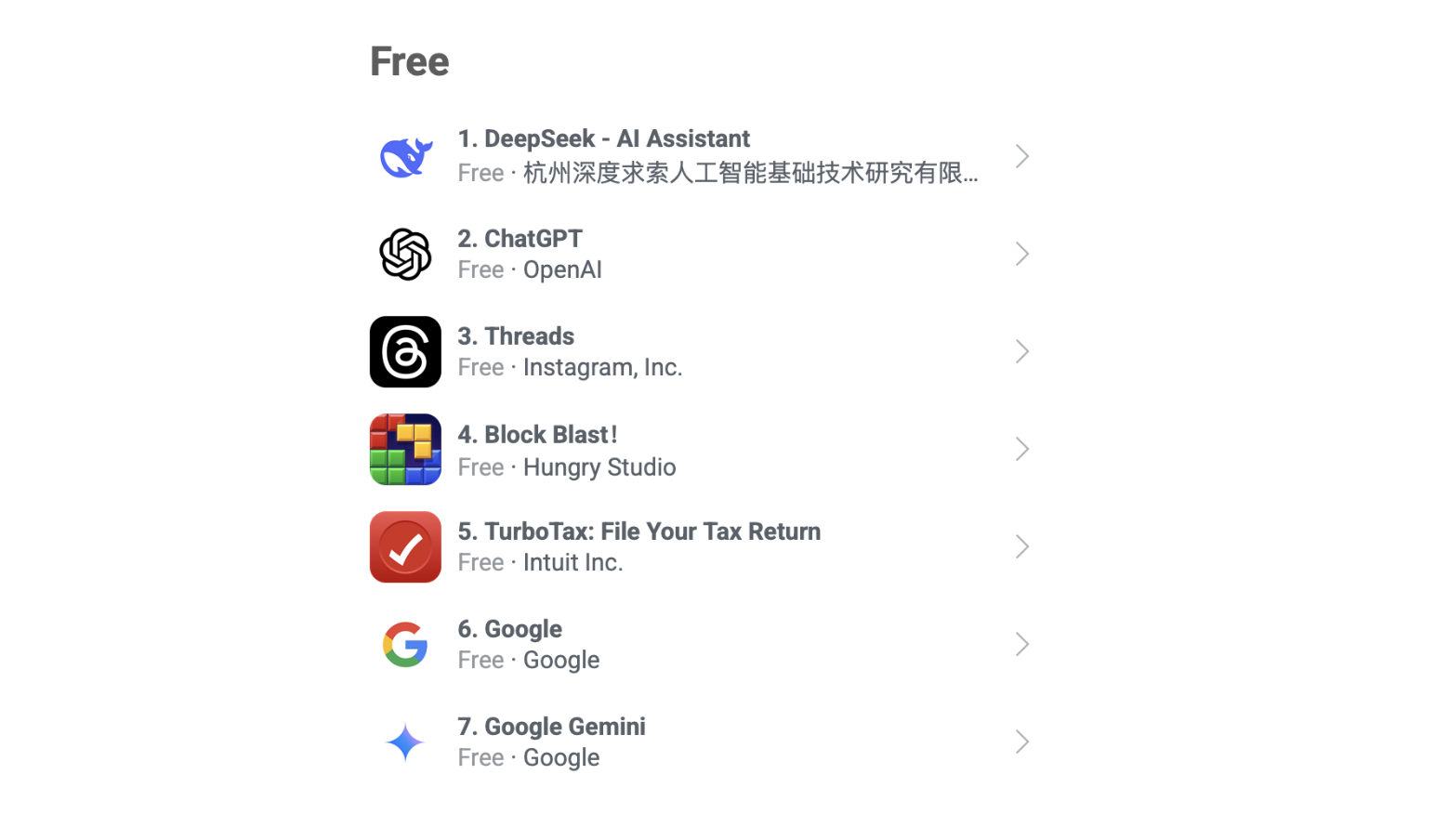
If its numbers are to be believed, DeepSeek spent less than $6 million to become the most downloaded app on the Apple iStore. And yet, OpenAI is reportedly raising money at a $300 billion valuation. Not sure I get that.
Can it be this predictable?
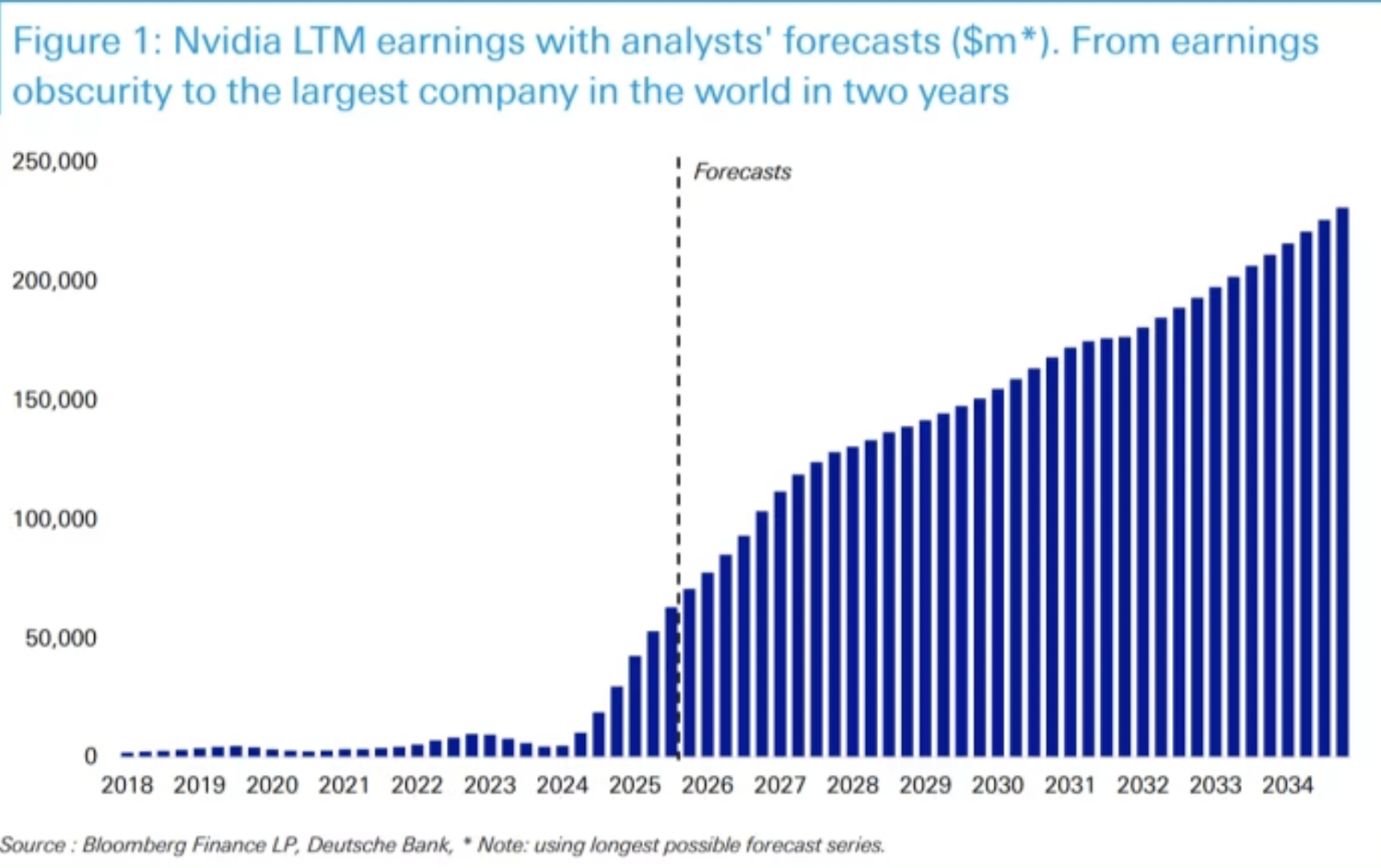
Here’s a chart of Nvidia earnings from Deutsche Bank. Could the march to $250 billion in annual profits possibly be that smooth? Investors questioned it this week.
Nvidia’s customers:
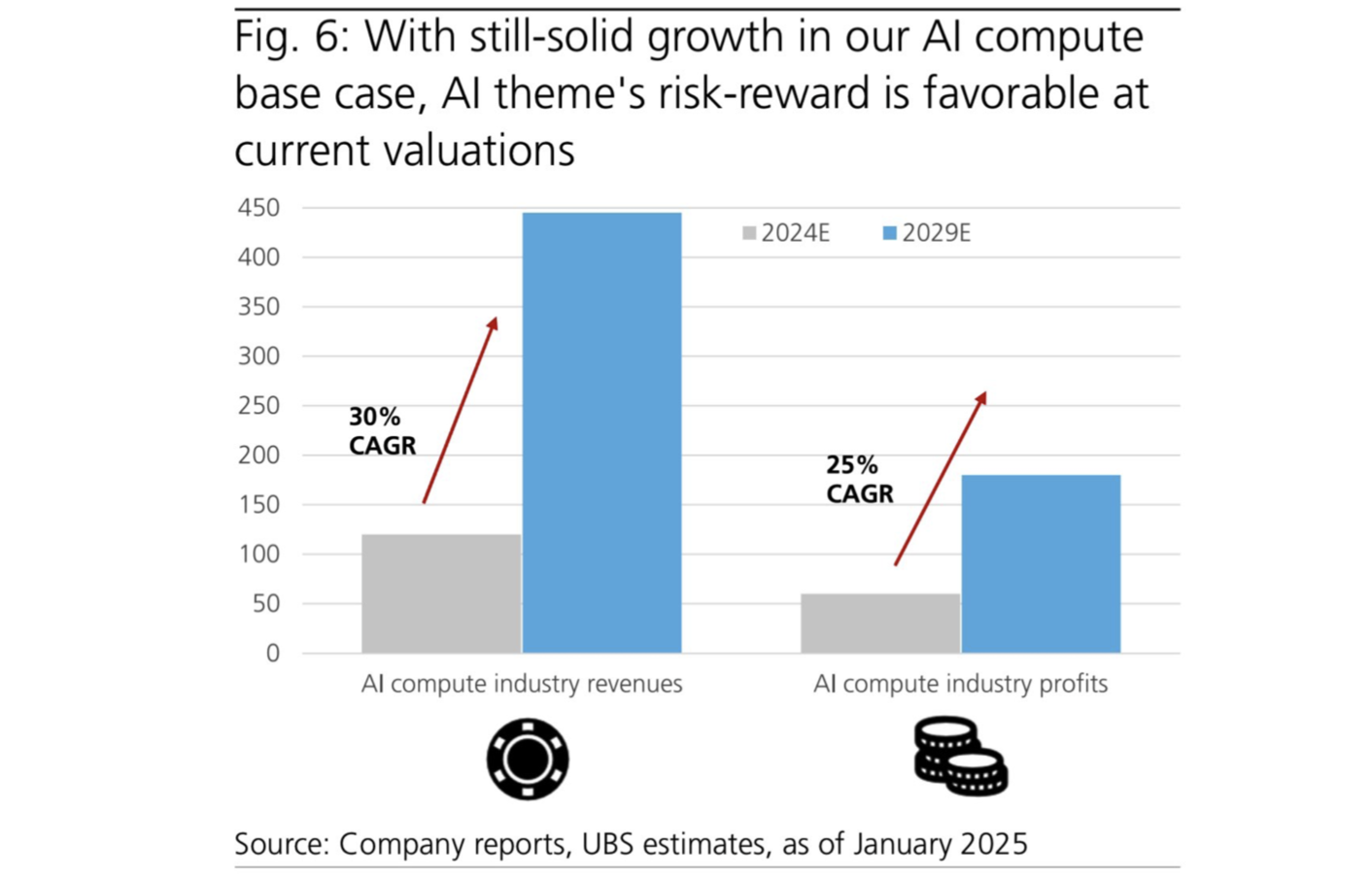
Despite DeepSeek, UBS expects earnings for the AI compute industry (i.e., cloud providers like Microsoft, Alphabet and Amazon) to grow 25% per year between now and 2029. Pretty good, even relative to their elevated valuations — but it’s also kind of strange that profits are expected to grow slower than revenue does. (Where are the economies of scale? The leverage on fixed costs???) That would be good news for Nvidia, if so (because cloud providers’ costs are Nvidia’s revenues).
Build baby, build:
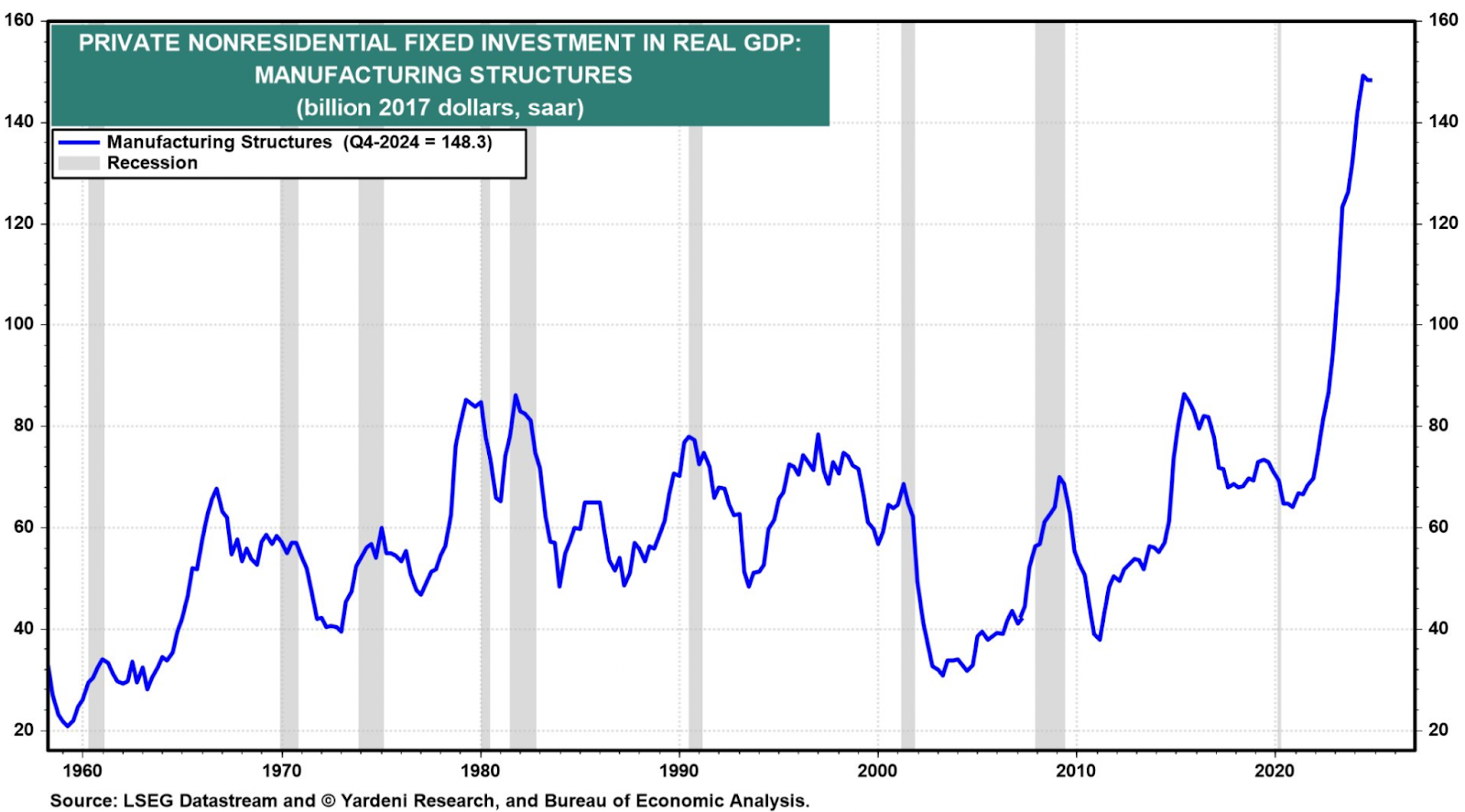
The frantic investment in AI data centers has led to a building boom in the US — possibly too much of one: If cloud providers use much more energy, there won’t be much left for everyone else.
Bubble territory?
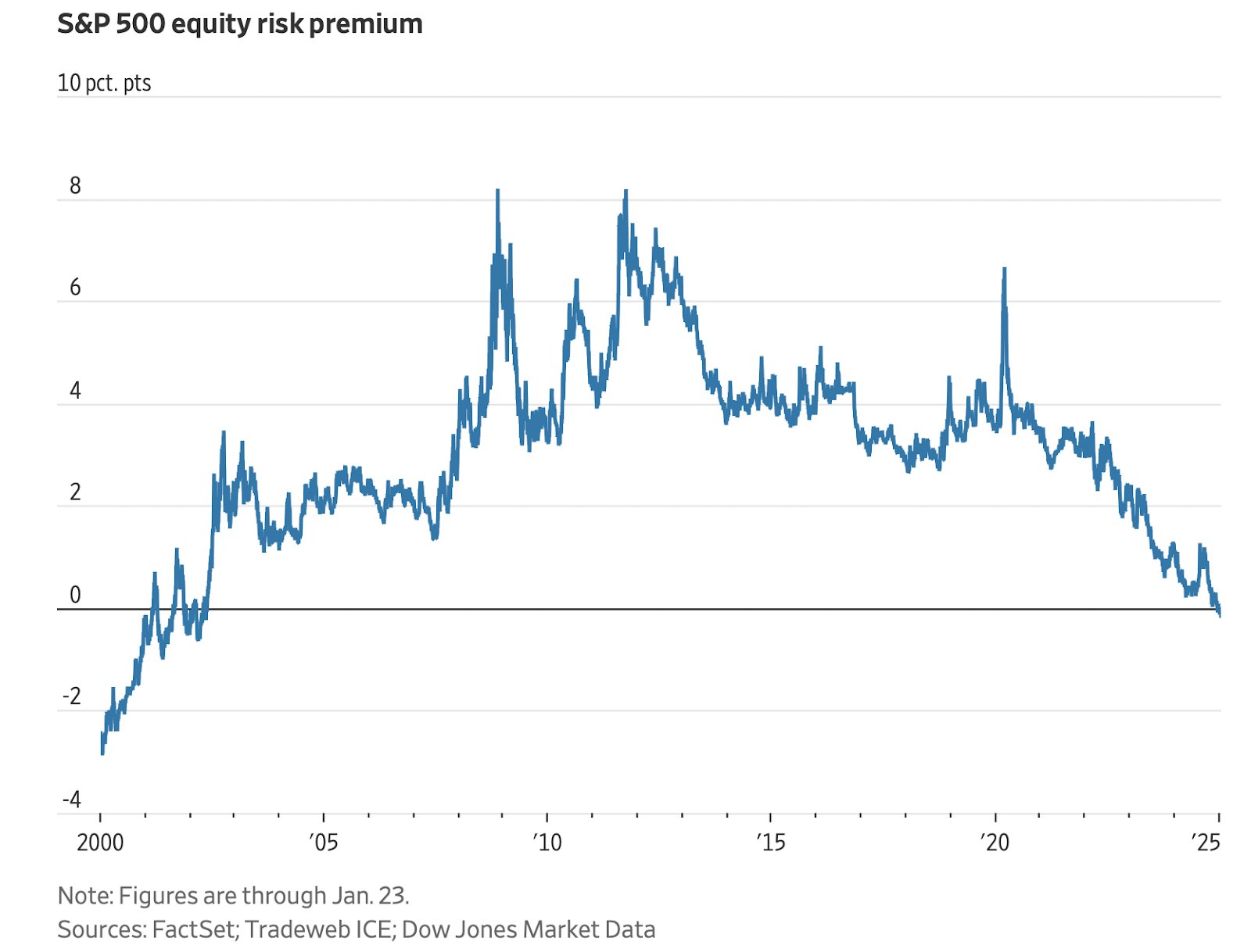
“Equity risk premium” is the thinking person’s valuation metric and it’s now making thinking people worry — the implied reward for owning stocks over bonds is back down to zero, the lowest level since the dotcom boom. Ray Dalio says it's a bubble.
The non-thinking person’s stock?
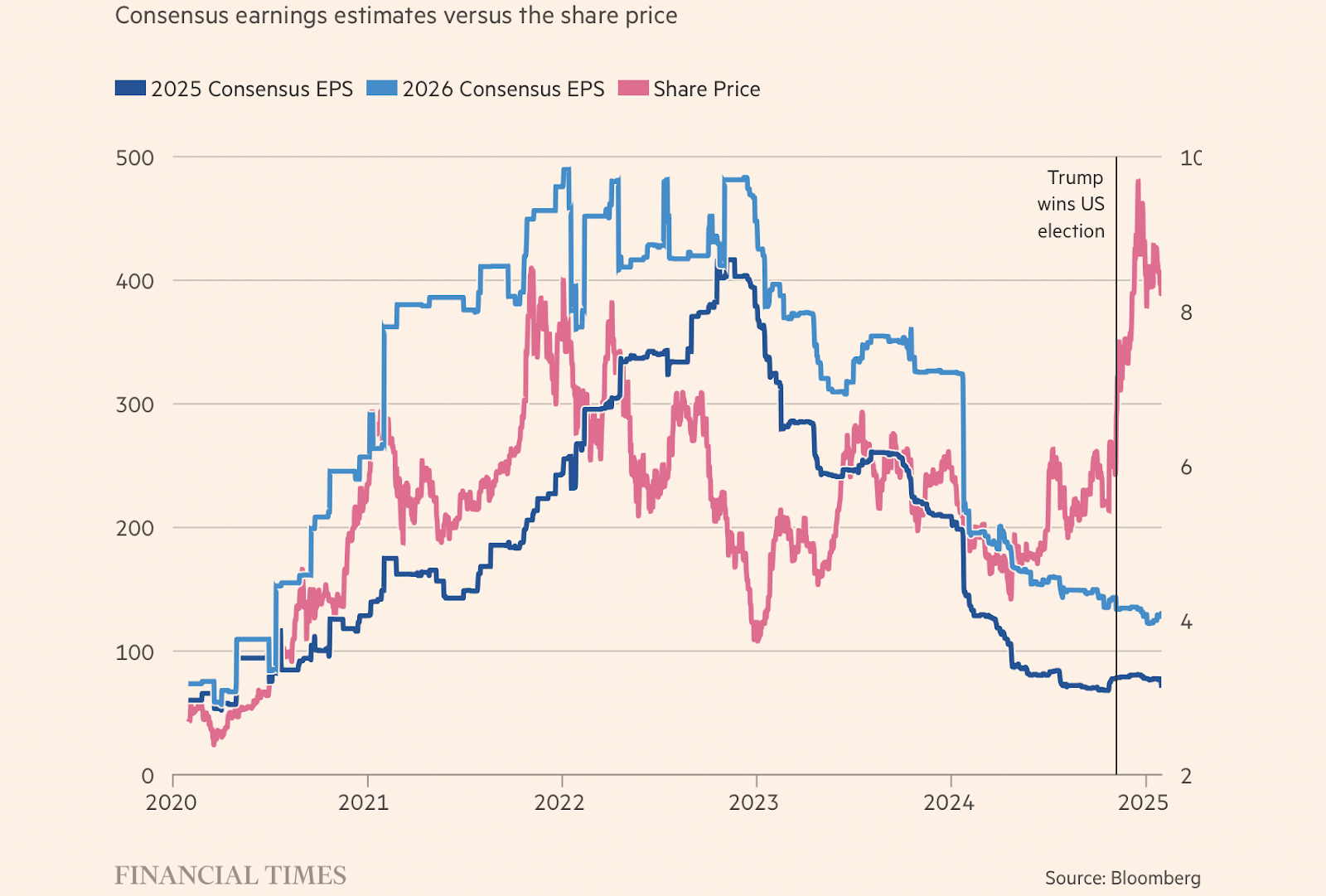
The trend in Tesla shares (up) has dramatically decoupled from the trend in Tesla earnings (down). That may or may not be a large red flag. Either way, this chart is an illustration of how dramatically Elon’s big bet on Trump has paid off.
Some non-tech winners:
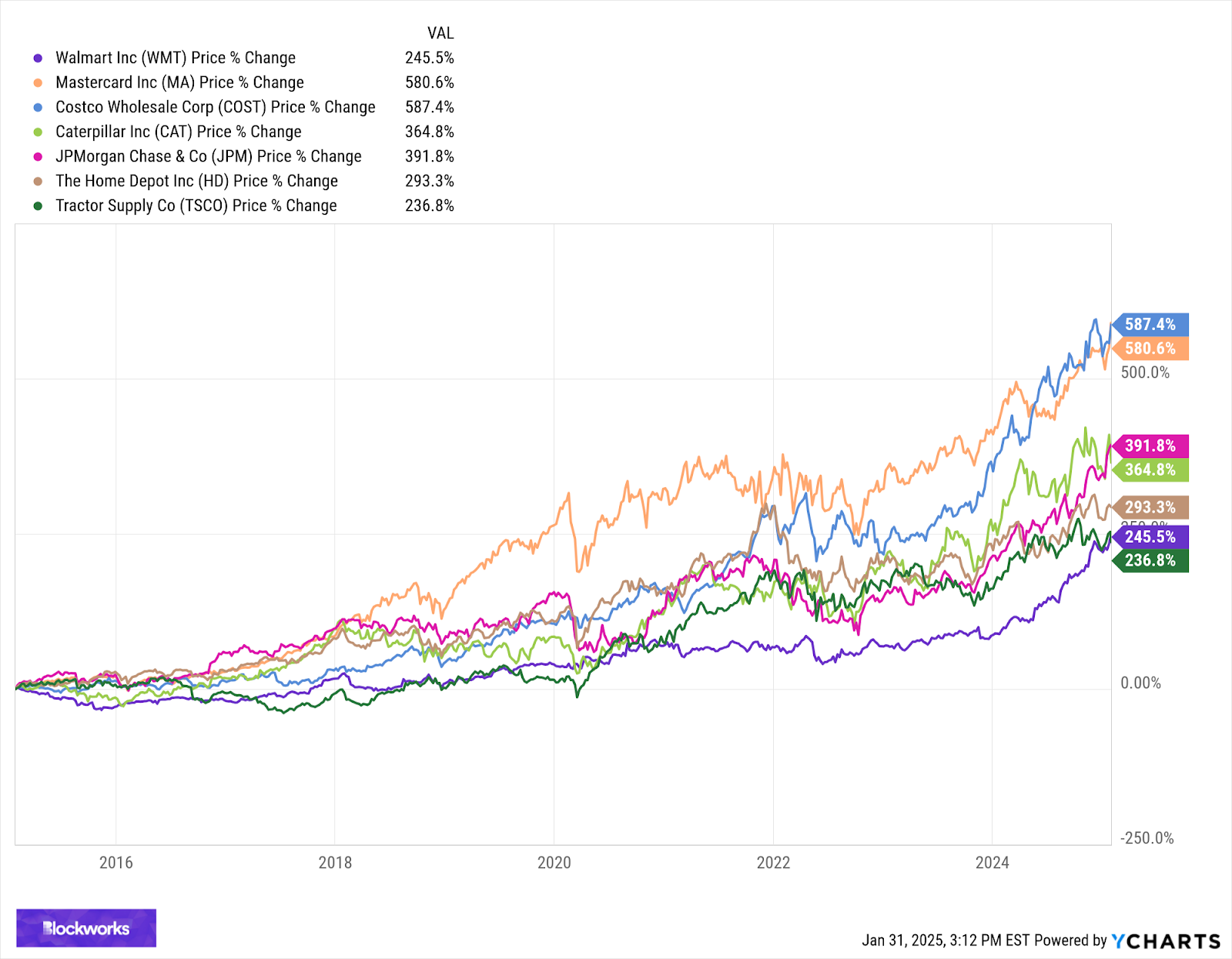
Here’s a reminder that you don’t have to invest in tech. Walmart and Mastercard, for example, are both up nearly 600% over the past decade. If you don’t believe in Jevons paradox, you’ll want to find some of these to invest in.
Not that it’s easy:
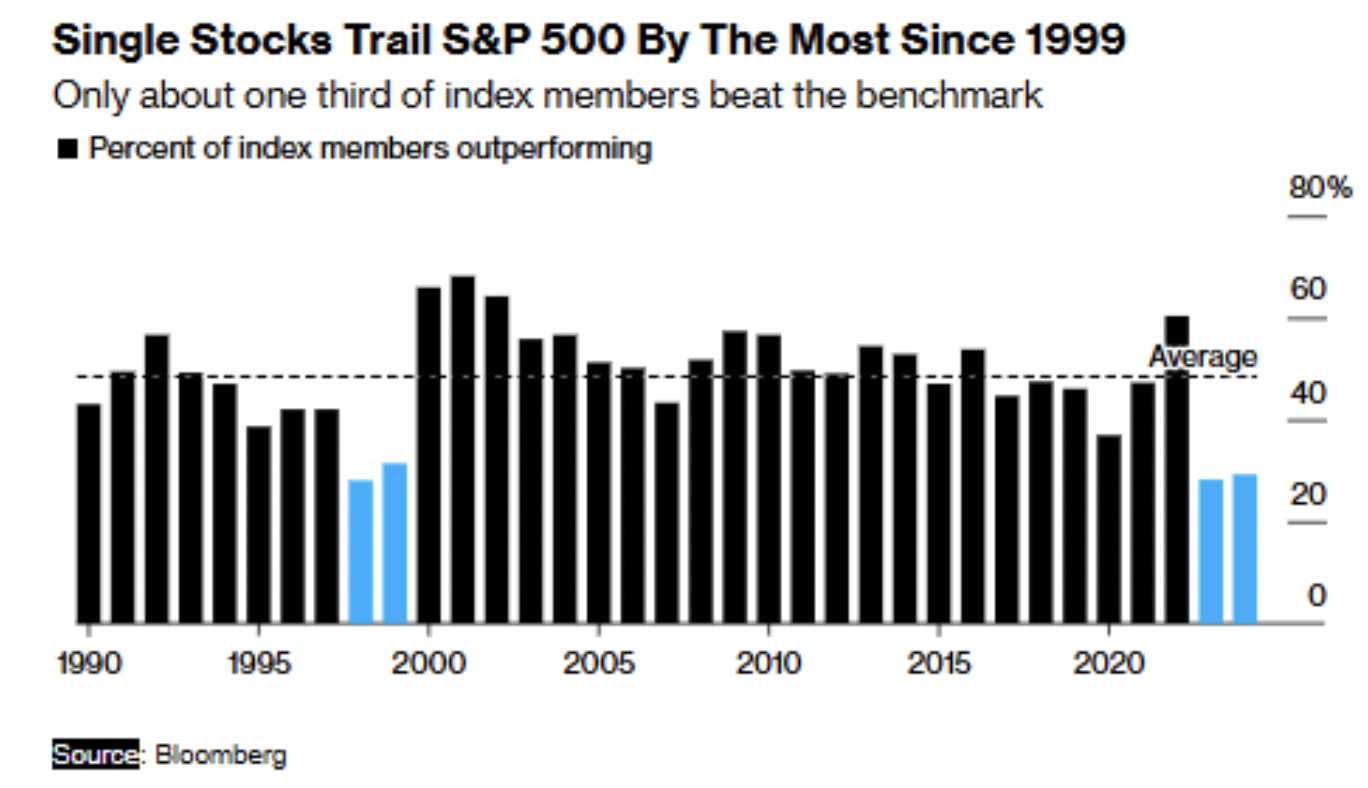
Per Bank of America, less than one-third of the stocks in the S&P 500 have outperformed the index over the past two years — the lowest number since the dotcom bust.
Speaking of the dotcom bust:
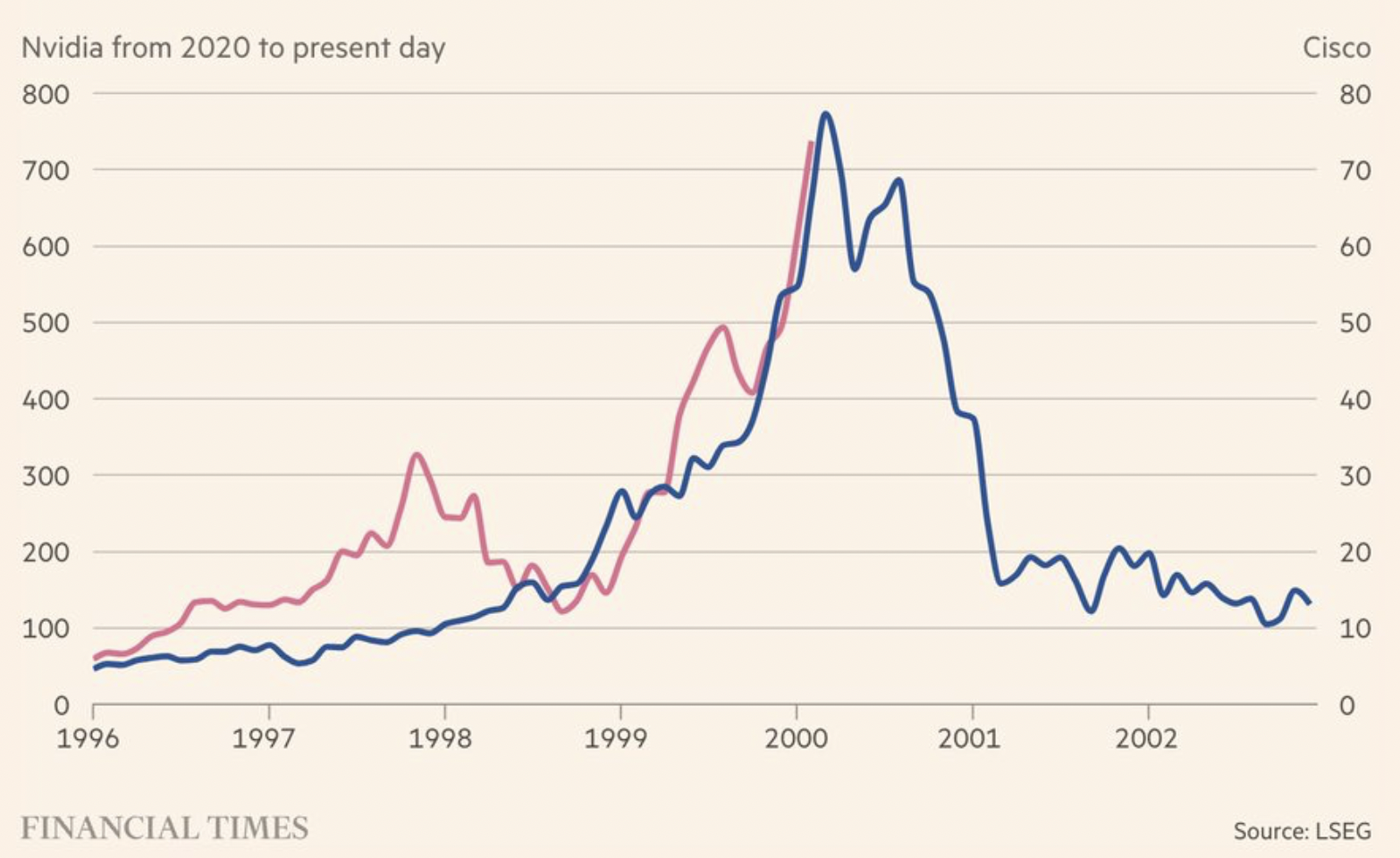
This chart is a little out of date, but Monday’s dramatic selloff in NVDA shares was eerily reminiscent of the bust in Cisco shares at the top of the dotcom bubble. Jevons paradox did not bail out Cisco investors then, so it’s maybe not a lock that it will bail out NVDA shareholders now.
The most bearish chart:
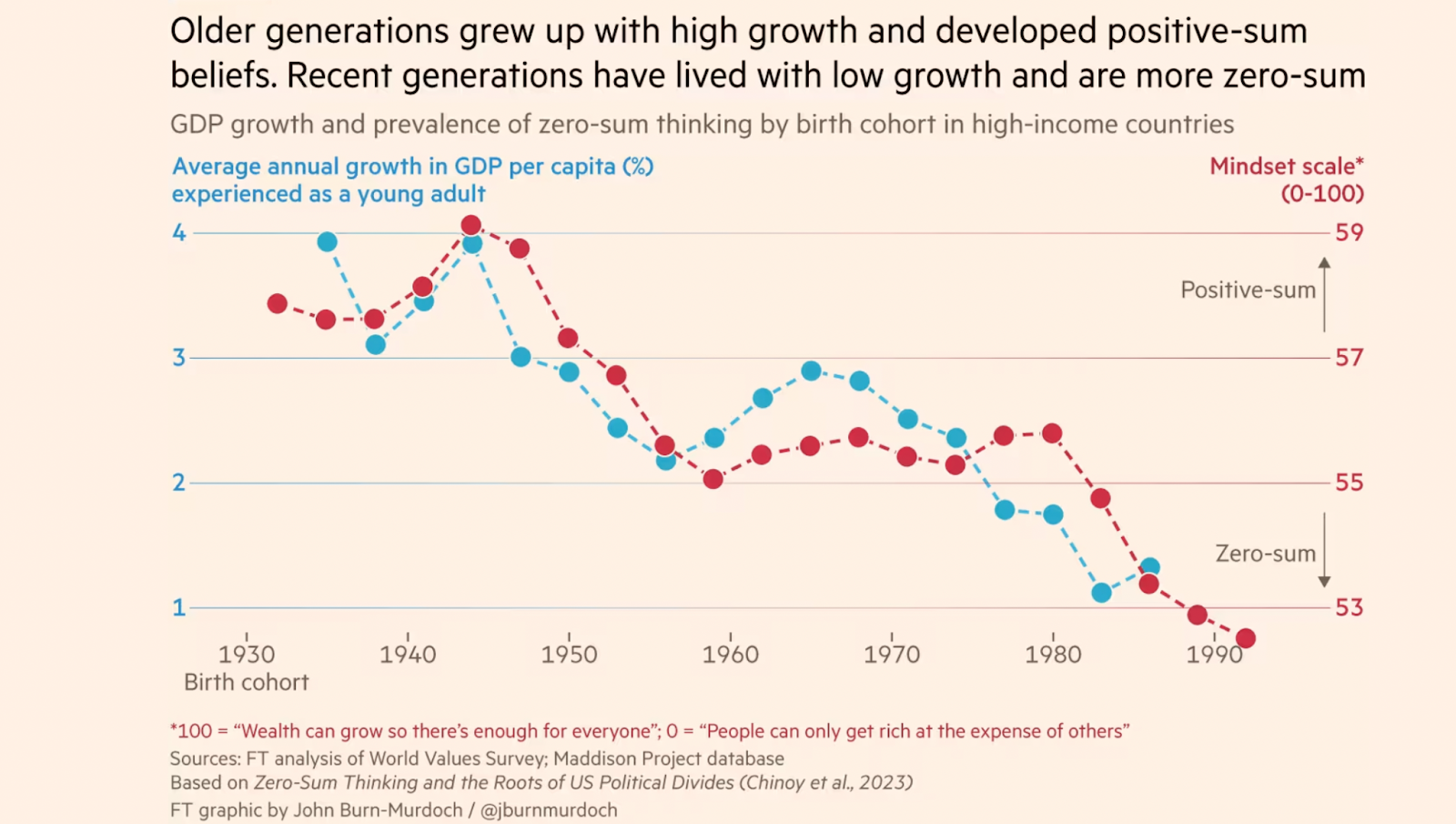
The FT notes that “zero-sum thinking” is on the rise — a pessimistic worldview that there’s nothing left to do other than squabble over a piece of an unchanging economic pie.
I expect that efficiency gains — in AI and elsewhere — will prove them wrong.
Have a great weekend, paradoxical readers.
The stakes have never been higher. As markets evolve and policy takes shape, Mohamed El-Erian will cut through the noise on macro trends. Anthony Scaramucci will unpack the changing face of finance and crypto. Kristin Smith will lay out the hard truths about regulation and its ripple effects.
📅 March 18-20 | NYC


The Solana Thesis in 2025

Kyle Samani joins the show to discuss his most recent piece. Tune in for a deep dive into his current thesis for Solana, bringing TradFi onchain and opportunities in DePIN and AI.
Listen to Lightspeed on Spotify, Apple Podcasts or YouTube.

i think its is near useless to think in terms of "are we in a bear market or a bull market" and instead:
"what is going to happen to this basket of assets on a weekly/monthly/3month timeframe"
"what is currently the best long setup"
"what is currently the best short setup"
— Ansem 🧸💸 (@blknoiz06)
8:20 PM • Jan 31, 2025
I am done with the energy in this industry that is all about the rug pull.
Fuck. That. Noise.
I got into crypto because I saw Wall Street ripping off retail and I’m honestly disgusted with the amount of that crypto has replicated and exacerbated this.
I don’t want to go there,… x.com/i/web/status/1…
— jill gunter ☕ (@jillrgunter)
11:40 PM • Jan 30, 2025