- The Breakdown
- Posts
- 🟪 Software as a founder



Software as a founder
Ronald Coase defined companies as “the system of relationships which comes into existence when the direction of resources is dependent on an entrepreneur.”
I’m not sure he thought too hard about that. Careful as that formulation sounds, he offered it as not much more than an aside, buried in a long exploration of why firms exist.
Still, it’s instructive: A company is not a legal entity, a payroll, or a balance sheet, as most would likely say. It’s a system of relationships — that exists to direct resources.
This framing matters now more than ever.
Yesterday, we discussed how AI agents could lead to a “Coasean singularity” in which the cost of coordinating activity through markets falls to zero. The day before, we discussed Coase’s answer to the puzzle of why firms exist: because there’s a cost to coordinating activity through markets.
So, you might conclude that if AI agents eliminate the reason why companies exist, companies will no longer exist either.
But this overlooks Coase’s definition of the firm — because, unlike humans, agents cannot direct resources.
“Humans have the ability to own property, to have rights, to take on liabilities, to create companies,” EigenCloud founder Sreeram Kannan explains. “Agents don’t.”
We humans have those abilities because we have legal standing. A company consisting of just an AI, by contrast, would not. Because who would sign a lease with an unaccountable bit of software?
But, per Coase, legal status is not what makes a company. Instead, it’s only what allows humans to direct resources.
So it stands to reason that an agent with the ability to direct resources in some other way would be able to form a company.
Kannan says the other way is blockchains: “Blockchains are the technology that allow programs to own property, have rights, and to take [on] liabilities,” he explained last week at DAS. “That’s what a smart contract is.”
By that logic, add an AI agent to a smart contract and — voilà! — you have a company as Coase would define it: an AI-entrepreneur that can direct resources.
That would, however, be a narrowly limited kind of company, because smart contracts can only direct resources that are fully onchain. This limits AI-agent businesses to just crypto-native things — DeFi, essentially.
But maybe not for much longer.
Human-run companies require both an identity (name, legal existence) and credentials (a deed, a signature, a title) to own and direct resources.
Agent-run companies should soon have the same: At DAS, Kannan pitched the crowd on EigenCloud’s “identity layer” for agents — a technical standard that provides agents with decentralized identity and reputation credentials.
Which is all they should need: “Agent ownership,” Kannan says, “equals agent identity plus credentials.”
Roughly speaking, this form of ownership will allow AI agents to incorporate on a blockchain in approximately the same way that human companies incorporate in Delaware.
Like a Delaware corporation, “agentic companies” will, for the first time, be able to 1) raise capital from investors and 2) own “assets outside of the blockchain.”
Not every kind of asset. Kannan cites the examples of “a website, a Stripe API key, a payment authorization, an app store app, a Roblox game” — all of which are digital.
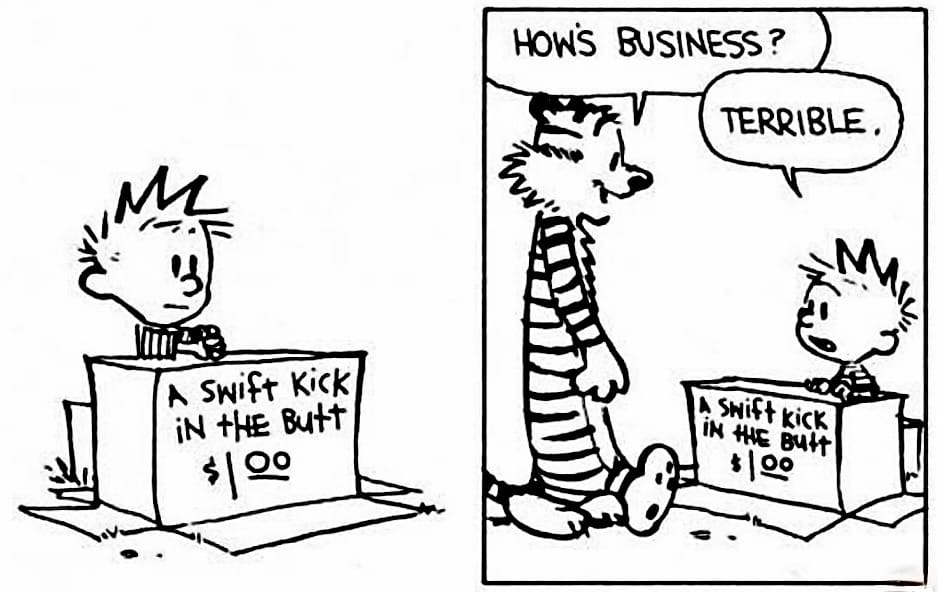
So Calvin’s butt-kicking business is not yet feasible onchain.
But new kinds of businesses will be.
“This is the first time we can take a company and just collapse it into pure software,” Kannan says. “We remove the team from the picture.”
This is the Coasean singularity: the moment the firm collapses into code, and coordination becomes a property of software rather than a team of people.
Agents will be companies.
Humans will be their investors.

Check out the previous two features in this series, which discuss why companies exist, what economic rules shape them, and how AI might change the equation.
Introducing Blockworks Investor Relations, an IR platform built for onchain businesses.
The latest Blockworks offering brings together analytics, a branded investor relations site, and integrated advisory support into a single platform. The result is a more efficient way to share your story, build trust with investors, and engage a global audience from day one.
If you’re building in crypto and want to upgrade your investor relations function, we’d love to work with you. Book a meeting with the Blockworks team to get started.