- The Breakdown
- Posts
- 🟪 The 24/7 messenger


The 24/7 messenger
Crypto has been unusually useful over the past week.
Its first act of service began Friday, when the Department of War designated Anthropic a supply-chain risk.
This sounded very much like a stock-market risk for the rest of us, because Anthropic is systemically important to our investment portfolios: Its spending supports the giant valuations of the hyperscalers we all hold in index funds, and its surging revenue is proof-of-concept that LLMs can be both useful and profitable.
But its shares are not listed on the stock market.
This has created something new in markets: Even passive investors are highly exposed to the fate of a company whose prospects cannot immediately be measured because there’s no stock price to tell us how things are going.
There is, however, a perpetuals price.
The value of Anthropic’s equity can be tracked on Ventuals, a crypto platform that offers perpetual futures (perps) on pre-IPO companies.
After the news Friday, the value of Anthrophic — as implied by the perps on Ventuals — fell from $540 to $475 billion. That’s less than I would have guessed given some of the breathless commentary I was seeing; some said the designation would force cloud providers to drop Anthropic as a customer, making its chatbot and APIs inaccessible (and therefore presumably worthless).
By Sunday, things looked even less threatening, with perpetuals rebounding to a $540 billion valuation. Today it’s up to $560 billion — above where it started.
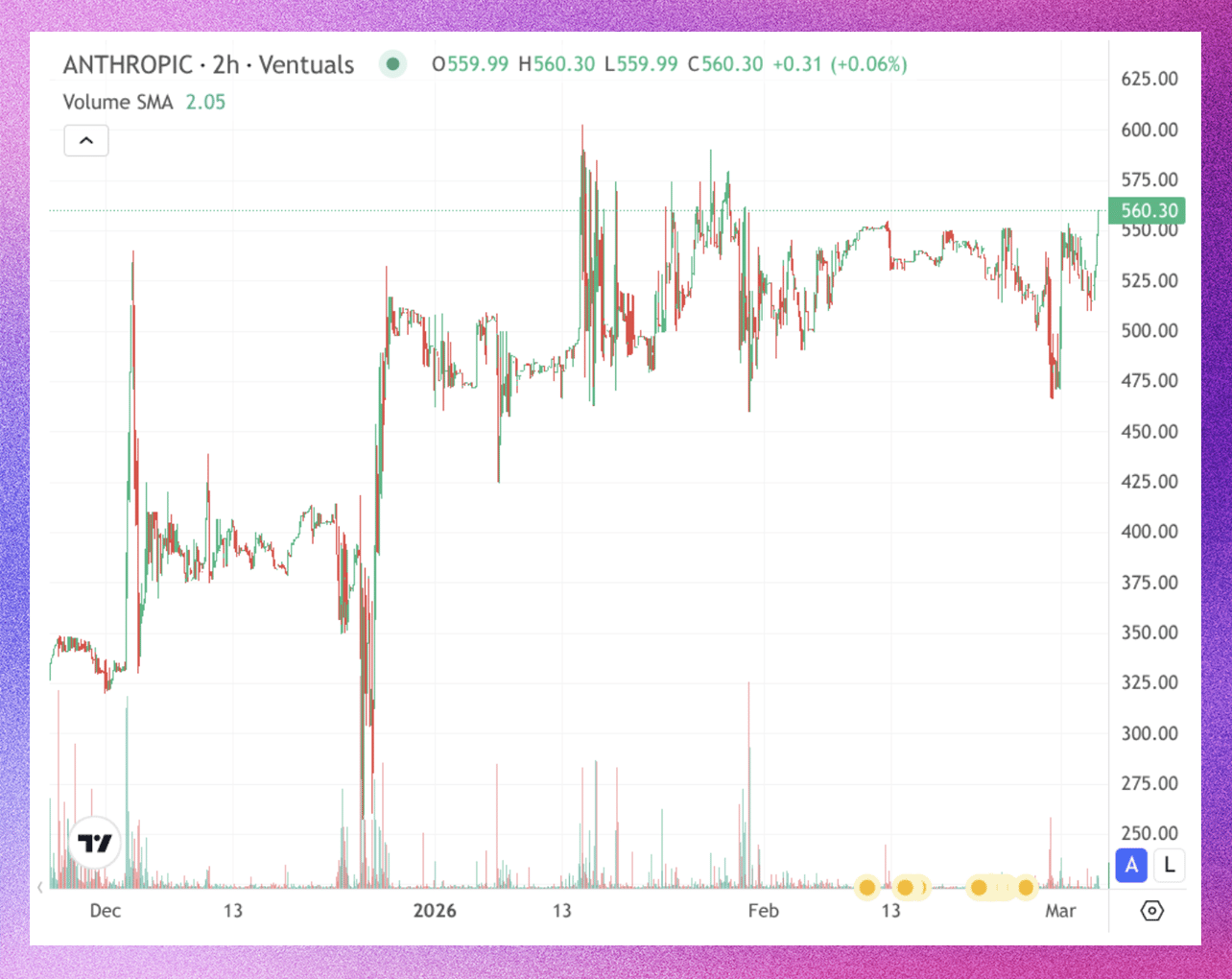
This is excellent information to have. And we wouldn’t have it without crypto.
You could, of course, read up on the legal basis of the dispute (in the fine print of 10 U.S.C. § 3252), the expert predictions on how it will play out (“a show of force that will not stick”), and the government’s point of view (surprisingly reasonable, but buried in a reply to a post with six likes on X).
But aside from newsletter writers, who has time to find all these things, let alone read them?
Even if you did do the work to form an opinion, you’d have to spend many additional hours figuring out what everyone else thinks, too (equally important for investing purposes).
Fortunately, a perpetual future did all that work for us. It took only a glance at Ventuals to know that Friday’s news would have little impact on Anthropic — and therefore none on your investment portfolio.
Very helpful.
Crypto’s next act of service came the following day, when the US and Israel launched a military action against Iran.
Traditional futures markets are closed on Saturdays, of course, so it was up to the perpetuals futures market to keep us informed.
Bloomberg begrudgingly acknowledged its usefulness:

“May offer” was underselling it, however. The prices were spot-on, as they always seem to be.
Still, Bloomberg did better than other financial media outlets, which waited until traditional futures resumed trading at 6 p.m. Sunday night to report how the weekend’s events affected the price of oil — something that affects nearly everyone, to one degree or another.
Prediction markets — also enabled by crypto — cut through a lot of this week’s noise for us, as well.
Polymarket currently lists 208 markets related to Iran, including one that puts the chance of the current regime falling by the end of the month at just 16% — only marginally higher than last week and lower than in January.

No amount of reading this weekend would have allowed you to figure that out on your own with any degree of confidence.
Prediction markets saved us some time last night, too.
At 9 p.m. ET, Polymarket gave James Talarico a 100% chance of winning the Texas Democratic primary for the US Senate.
Two hours later, The New York Times ran the headline: “Tight Races in Both Texas Senate Primaries.”
Clearly, they should have been checking Polymarket, because crypto-enabled prices were conveying news far faster — and more precisely — than anything else.
As the news of the world gets ever-more complicated, that’s a service that will get ever-more useful.

Brought to you by:

ZKsync is the Bank Stack of Ethereum. ZKsync’s Prividium is the only Ethereum-secured blockchain platform purpose-built for institutions that demand privacy, compliance, and full control of their data.
Designed for enterprises, Prividium offers user-level privacy, compliance, cross-chain connectivity, and Ethereum-grade security out of the box. More specifically, Prividiums:
ensure that sensitive data never leaves enterprises’ infrastructure
combine role-based access controls with ZK proofs to make requirements such as AML and KYC enforceable and verifiable
give operators full authority over governance and transaction ordering
connect natively to Ethereum
Private where it matters. Connected where it counts.


DAS NYC's lineup is bringing the biggest names in finance to the stage.
Don't miss the institutional gathering of the year — this March 24−26.

