- The Breakdown
- Posts
- 🟪 The zero-knowledge case for blockchain


The zero-knowledge case for blockchain
Eli Ben-Sasson’s crypto origin story begins in 2013 when he first realizes the work he’d been doing for intellectual joy might have a practical purpose.
On a two-year sabbatical (who knew there was such a thing?), he attended a Bitcoin conference to give a technical talk on his area of expertise: “an obscure branch of mathematics known as validity proofs.”
Now more commonly known as “zero-knowledge proofs,” this is the idea that you can prove something is true without revealing anything about the content of the proof. With these, Ben-Sasson explains, “The only thing people learn is that something is true.”
He’d spent his career developing the theoretical math required to make that happen — without much thought of it ever actually happening: “my work had been beautiful but distant.”
In Zero-Knowledge, Infinite Trust, Ben-Sasson recounts the fateful conference that brought his work much closer.
“I tossed the presentation I’d prepared… I wrote a new one from scratch with only one driving objective — to connect my work to the energy and excitement I saw there. And in the hours after I delivered my speech, the reactions changed the path of my life.”
His research “suddenly seemed relevant.”
This happy realization, he explains, felt like inventing the perfect milk frothing machine right before the world fell in love with cappuccino.
Not everyone would have started making cappuccinos, however: “Some theoreticians wondered why I was wasting my time on implementation,” Ben-Sasson says.
Co-written with Nathan Jeffay, his book is in large part an explanation of why he decided to spend his time on implementing blockchain technology: “Building trust without centralized power,” he says, “was exactly what my work was designed to solve.”
The book reads like a throwback to when crypto was all ambition and potential — when it was too early to worry about disconfirming evidence, and hypotheses (always stated as certainties) were as yet unfalsifiable.
Unlike many, Ben-Sasson still sees the potential: “Blockchain is the best hope we have for integrity in human society,” he says.
Once commonplace, that kind of big-picture claim is now discordant with today’s more-chastened sentiment — we’ve collected a lot of disconfirming evidence over the last few years.
But Ben-Sasson seems immune to disillusionment. Blockchain technology, he still believes, is necessary, a “moral opportunity,” and indispensable. “The central argument of this book,” he says, “is that everyone needs it.”
He says this while acknowledging crypto’s critics and their standard arguments: that the tech is a solution in search of a problem, that the coins are all Ponzis, etc. Unusually, he does so without rancor, which is refreshing — you know it’s a different kind of crypto book when the author says something nice about Paul Krugman.
Maybe that’s the mathematician in him: Ben-Sasson seems to have developed a professional tolerance for ideas that take decades to matter.
Zero-knowledge proofs, for example, entered the public consciousness as early as 1987 when a New York Times headline announced, “A New Approach to Protecting Secrets is Discovered.”
And yet, it wasn’t until 2013 that Ben-Sasson thought this new approach could become relevant to the public.
Even thereafter, more perseverance was required. The zk-proof system he developed for blockchains was widely rejected by academic journals, Ben-Sasson says. When he made a breakthrough on verification techniques (known as FRI), fewer than ten people showed up to hear him present it.
But his conviction stems from even earlier than that. Before he had finished the math, he had a “gut feeling” these things would work.
He has the same feeling about blockchain. Despite its slow uptake, Ben-Sasson believes “we will look back to this time in history and realize that the question should have been ‘What won’t we use it for?’”
He says that because he expects blockchain will merge into a new, verifiable form of the internet:
The deeper vision behind everything in this book is a future we call the Integrity Web — a new kind of internet infrastructure. It’s one where the systems we rely on don’t ask for our trust; they prove they deserve it.
This vision of an Integrity Web matters because today intermediaries sit in the middle of almost everything we do; even everyday acts like paying bills, claiming benefits, updating records, or posting online depend on opaque systems we didn’t build, can’t audit, and often shouldn’t fully trust.
It’s no longer safe to assume these systems are universally neutral and fair, and that’s exactly where the Integrity Web comes in.
It’s an expansive vision of decentralization — which Ben-Sasson believes should be more popular than it is. One reason it’s not, he says, is because its advocates “focus too much on how and not enough on why.”
Hence the book, which explains a little bit of the how and a lot of the why — all in a way that will be accessible to people entirely new to the subject.
For those who might think they’ve had too much of the subject, it offers a reminder of why blockchain seemed promising in the first place.
For anyone who’s not a cryptographer, it’s a surprisingly comprehensible explainer on the technology behind zero-knowledge proofs and what they might be used for.
So this is probably the book that crypto needs now.
Or, to use the authors’ preferred term: the book blockchain needs now.
Ben-Sasson is a cryptographer and co-inventor of crypto's most cypherpunk project, Zcash, but he prefers the term “blockchain” to “crypto.”
This is mostly for PR reasons. He recognizes that the brand of “crypto” has been tainted by the many speculations, grifts, crashes, and frauds it’s suffered through. So he and his co-author used the term “blockchain,” instead.
Not “blockchains” or “the blockchain.” Just blockchain.
“In the future,” they write, “the internet and blockchain will be indistinguishable.”
“This turns blockchain into a mass noun: not something you count, like “all the new blockchains,” but a pervasive societal substrate, like “technology” or “finance.”
It’s the difference between saying “New technologies will change the world” and “Technology will change the world.”
The first invites questions: which ones? Why? The second is declarative. It’s inevitable.
By making blockchain a mass noun, the authors elevate it to an inevitability.
Which is what they think it is: “What blockchain offers is such a unique fit for the deep needs of humanity that its mass adoption is inevitable,” they conclude.
That’s a lot to ask of a singular noun — even a mass one — so “inevitable” might be overstated, I don’t know.
But the optimism is welcome — and sorely needed.

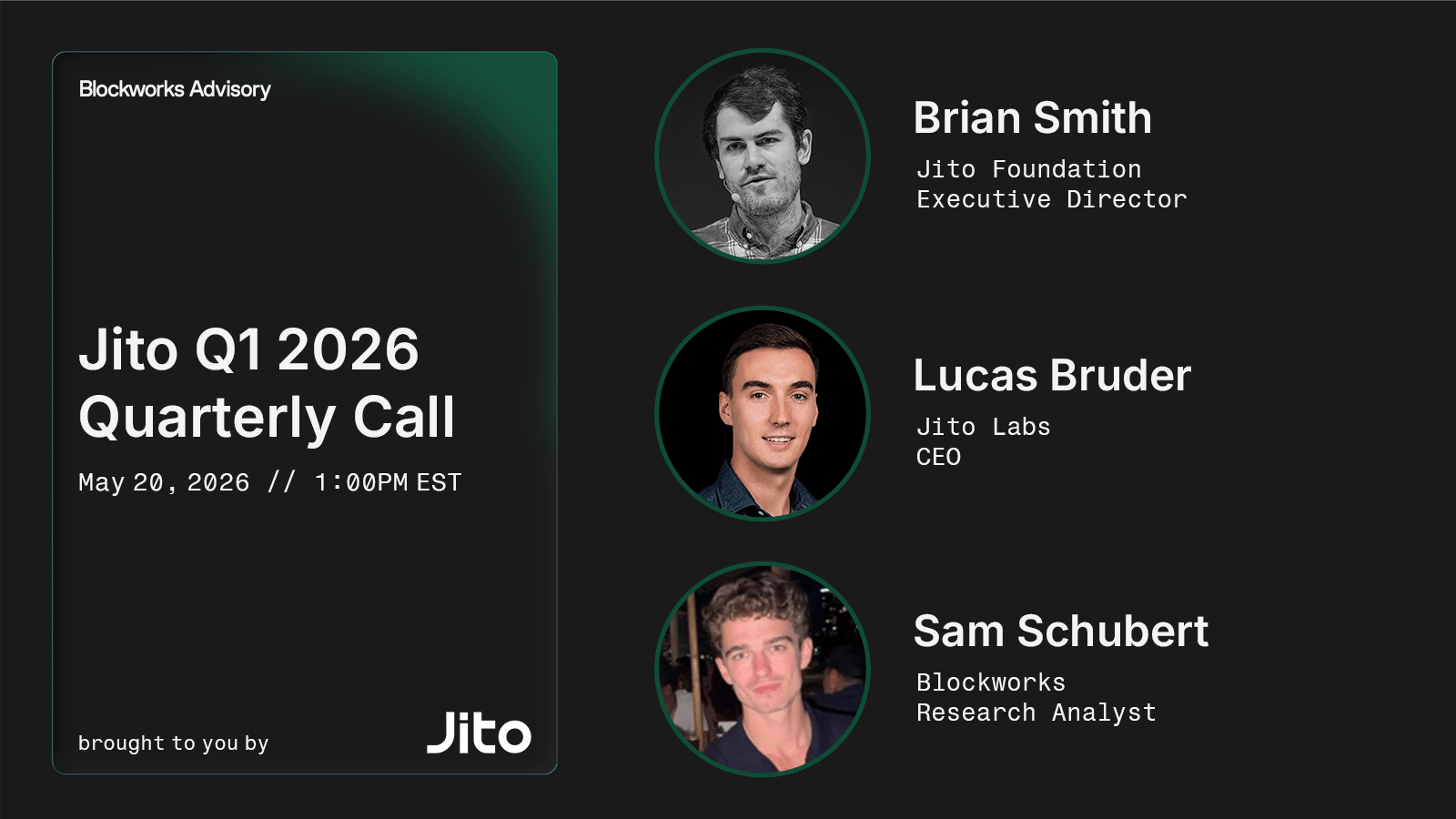
Q1 was a transformative quarter for Jito, marked by rapid validator adoption of BAM and growth in institutional distribution channels.
Join us in partnership with Jito for their official Q1 Quarterly Call, where we’ll break down the numbers, trends, and key takeaways from Q1 for one of crypto’s most influential protocols.
On Wednesday, May 20 at 1 pm ET, watch the call live from X, YouTube, LinkedIn or Blockworks.com.