- The Breakdown
- Posts
- 🟪 Thursday links


Thursday links: Peterffy, Saylor and Do Kwon
Thomas Peterffy might be the most underrated figure in the history of business and finance.
The low-profile founder of Interactive Brokers emigrated to the US from Hungary at the age of 21 (60 years later, he still has the accent to prove it) with just $100 from his father in his pocket.
He turned it into $83 billion.
That’s partly because he was far better at math than nearly everyone on 1970s Wall Street: Before the advent of the Black-Scholes pricing model, making money in options was like shooting fish in a barrel for him.
It’s also because his English wasn’t very good. In his first job, as an engineer, he was drawn to an Olivetti 101 computer that no one in the office was using. “I figured it would be easier to learn than English,” he explains.
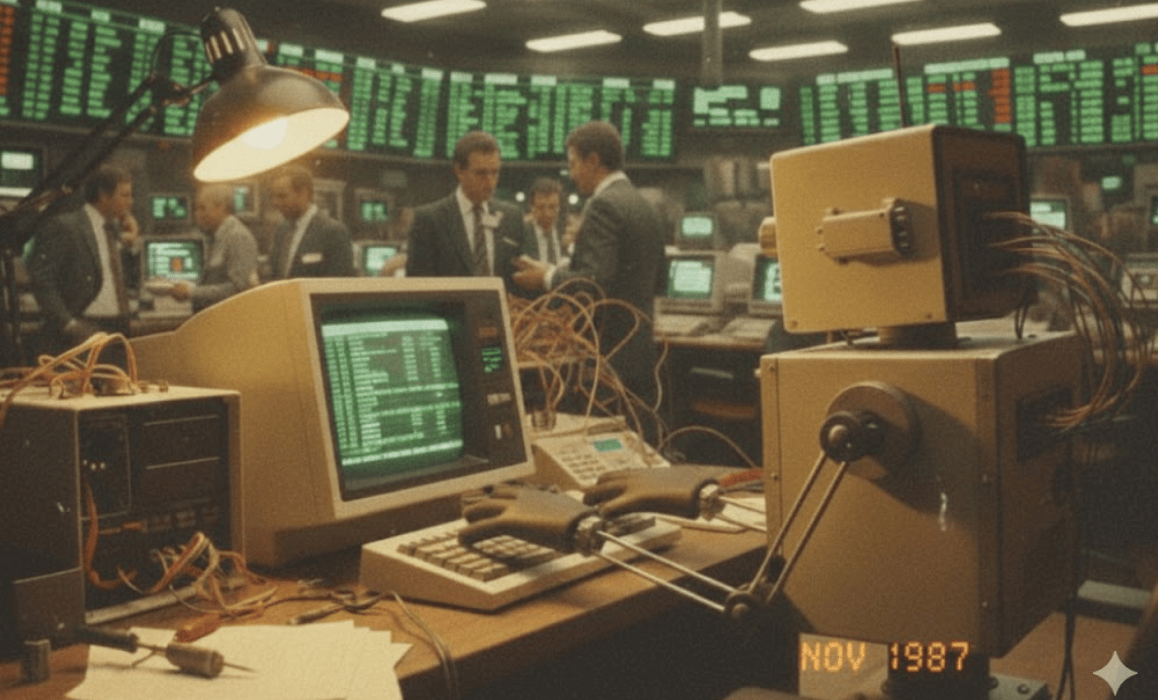
Peterffy later used those programming skills to automate his trading on NASDAQ, by hijacking the terminal’s data line — wiring it into his own computer to pull live prices and send trades back through the same cable. When the exchange discovered this, they gave him one week to comply with a new rule: All trades had to be manually typed into the keyboard, one at a time.
So he built robots to type the orders into the terminal for him.
Also, he just worked harder than anyone else.
And still does: At 81 years old, the man is now the 18th richest person in America. But he still spends his time sussing out the next big thing in finance — which he thinks is prediction markets.
On the most recent earnings call for Interactive Brokers (which he, unusually, participates in as Chairman), Peterffy said that, while other prediction markets are focused on sports and celebrity gossip, he is focused on providing markets in something much more substantial: temperatures.
Temperatures, he notes, determine electricity use and energy prices — “so this is a way for us to back into the entire economy.”
They’re already seeing strong demand for these temperature markets, and he thinks markets on wind speeds might be the next thing they offer. And then, well, pretty much everything: “We are going to get into shipping, transportation, insurance, all over the globe.”
As incredibly successful as he’s been, he thinks this will be his biggest opportunity yet: “I believe this market will be much, much, much larger than the securities market,” he told CNBC. “Because it’s all the questions about our future.”
I find that hard to believe, simply because the securities market is gargantuan: The US equities market alone is worth over $75 trillion. Fixed income is worth another $60 trillion.
But taking the other side of a Thomas Peterffy bet has always been a terrible idea.
The New York Times’ Rob Copeland gets some good zingers in at Michael Saylor’s expense: Strategy’s new, well, strategy of keeping a reserve of US dollars, Copeland says, is “roughly the equivalent of Heinz’s saying it is beginning to see the merits in Hunt’s ketchup.”
But Saylor remains all-in on the Bitcoin meme, according to Copeland’s account of a recent party at Saylor’s “Tuscan-style Miami compound”:
Matters got considerably weirder at dinnertime, however, when fluorescent green lasers shot out of the host’s eyeballs, or so it appeared to hundreds of guests seated around giant screens erected on the billionaire’s lawn on New Year’s Eve 2024.
The screens plopped Mr. Saylor’s visage into famous films, such as “Gladiator” and “The Lord of the Rings.” He was edited into the action as a hero whose eyes blasted wealthy cryptocurrency skeptics including Bill Gates and Jamie Dimon, the bank executive.
“Buy!” cried Mr. Saylor’s avatar, as opponents were vaporized.
I only know Saylor from his over-the-top advocacy of Bitcoin. And because his stage presence is subdued even when making the most outlandish claims about it, I assumed he was kind of a conservative business guy who was transformed by his excitement for Bitcoin. But it turns out he’s always been over-the-top excited:
In 1998, the year MicroStrategy became publicly traded, [Saylor] predicted a day when “everybody on the planet lives every hour of every day dependent upon our technology.”
It makes sense, though, because it takes a special kind of person to go all-in on a bet the way that he did with Bitcoin — especially since he did so after only a few poolside discussions with his Miami neighbor, Eric Weiss.
Mr. Weiss suggested a small personal investment in Bitcoin, according to the interviews both men have given. Mr. Saylor surprised him in June 2020 with a phone call to announce that he had personally bought $100 million worth, while Bitcoin was trading around $10,000.
$100 million! Incredible.
Saylor is now worth about $5 billion thanks to the runaway success of Strategy. Helpfully, Copeland concisely explains the risks they’re taking:
Buying Bitcoin and waiting for it to go up, as is Strategy’s mission, does not leave any money with which to pay cash dividends.
As of this month, Strategy owes $21 billion to its lenders and preferred shareholders. It is on the hook to pay more than $844 million to investors in the next year.
Finally, Copeland reminds us of the risks inherent to Strategy's convertible bonds. These have always been self-evident, but now that the numbers have gotten so big, is nonetheless kind of alarming to see it spelled out:
As soon as next year, Strategy’s convertible debt holders — the ones who lent money for as little as zero percent interest — will expect to swap into stock that Strategy had promised would be worth as much as $672 a share.
If it doesn’t trade at that level — it is currently around $171 — Strategy will have to find money to bridge the difference. In the next three years, $5 billion of such loans are due.
Strategy’s market capitalization is currently $47 billion, so they should be able to scrape up $5 billion one way or another.
But it really is an over-the-top bet.
Inside the trial of Do Kwon
Mathew Russell Lee’s trial reports, loosely structured and conversational, always make me want to serve jury duty.
Weird, I know, but he makes the trials sound fun — Lee’s transcript of the Do Kwon trial, for example, includes some good laughs:
Judge Rakoff: Juror 8 is really well dressed today [some laughter in the courtroom]
And here:
Judge: What is your status in this country?
Greenwood: I am an inmate [laughs].
There are also a lot of inadvertently funny things:
SEC lawyer: What did you mean by that?
Curran: I’m not sure.
The intersection of crypto investing and US law can be amusing, too:
Judge Rakoff: Let me ask the witness, some crypto currencies are more risky than others, correct?
Terraform’s lawyer: Objection!
Judge Rakoff: Overruled.
You also learn some random things, like how lucrative it is to be an “expert” crypto witnesses:
Judge: You were paid $1400 an hour.
Some helpful things…
Do Kwon lawyer: What does LMFAO mean — don’t say if it has a profanity.
Curran: Laughing my FA off.
…and some amazing things:
Witness: While I was still at Jump we were receiving one million Luna a month.
That works out to $119 million a month at Luna’s peak — just for market-making!
In this trial, it helps that the judge appears to be something of a card:
Judge: Why is the name of the company that tried to maintain the peg in May 2021 kept confidential?
Counsel: They asked for it.
Judge: I’m about to say their name…
Counsel: … The material is confidential.
Judge: The name of the company is Jump.
Judge: Jumping right into it…
And:
Judge: I need to leave to teach criminal law at Columbia Law School. After that, I’m sure you’ll think it’s frivolous, my wife and I go dancing.
He also tells it like it is:
Judge: This case is about lies.
Aside from the entertainment value, though, snippets of the testimony may also be the most intuitive way to understand why Do Kwon found himself in a Montenegrin prison, whereas the bankers at Lehman Brothers or the developers of the OHM token did not.
Witness: There was a gentleman’s agreement not to mention that Chai wasn’t using the Terra blockchain. Some of these guys had life-changing amounts of Luna. This kept the value up.
Witness: I thought it was sketchy. Then I saw an interview online of Do Kwon where he was saying Chai used the Terra blockchain, which was very not true.
Witness: Basically, transactions done on Chai were just copied and pasted into the Terra blockchain, to make it appear that had happened there. They hadn’t.
With that, the jury’s verdict was predictable: “Liable, liable, liable — and reckless, not intentional.”
Do Kwon was found “liable” and not “guilty” because this was the civil case against him. His criminal trial is still to come.
Judge: Trial starting January 26, 2026, then.
Should make for a fun read!

Brought to you by:

Institutions and DeFi are converging on Canton, creating real-world finance with crypto-style speed.
The latest The Tie report shows growing demand for privacy, composability, and sustainable tokenomics.
With 575+ validators and 600K+ daily transactions driving on-chain activity, Canton’s network momentum is accelerating on-chain global finance.


Crypto's premier institutional event is returning to NYC this coming March 24-26.
Get your ticket today with promo code: BREAKDOWNNL for $100 off.