- The Breakdown
- Posts
- 🟪 Too funded to fail



Too funded to fail: Crypto needs a forest fire
Arboreal ecosystems operate on a brutal but necessary paradox: For a forest to grow, it occasionally needs to burn.
Without these seemingly apocalyptic conflagrations, the forest floor becomes choked with underbrush, preventing the new growth needed for regeneration and long-term viability.
Dion Lim says this is how technology cycles work, too.
“The first web cycle,” he explains, “burned through dot-com exuberance and left behind Google, Amazon, eBay, and PayPal: the hardy survivors of Web 1.0. The next cycle, driven by social and mobile, burned again in 2008-2009, clearing the underbrush for Facebook, Airbnb, Uber, and the offspring of Y Combinator.”
The speculative frenzy of investment bubbles burns off non-productive capital much like a wildfire consumes dense fuel — and the inevitable crash clears the way for the market’s resources to be reallocated.
Without these seemingly apocalyptic market conflagrations, a permanent underbrush of failed startups would drain the technology sector of the resources it needs to grow.
This might be why crypto feels so left behind this year: A tangled undergrowth of big projects that never seem to die has been hoarding the resources the ecosystem needs to evolve.
In the real economy, labor is constantly being reallocated from failed companies to successful or promising ones: “Many of Google’s best early employees,” Lim notes, “were founders or early employees of failed Web 1.0 startups.”
This seems to happen less in crypto.
To cite just one example, the Polkadot blockchain — which collected $72 of fees yesterday — is supported by 482 full-time developers and 1,404 contributors.
If a project like that — in its sixth year of operations — was funded by stock and not tokens, I’m guessing those resources would have been released back into the ecosystem by now.
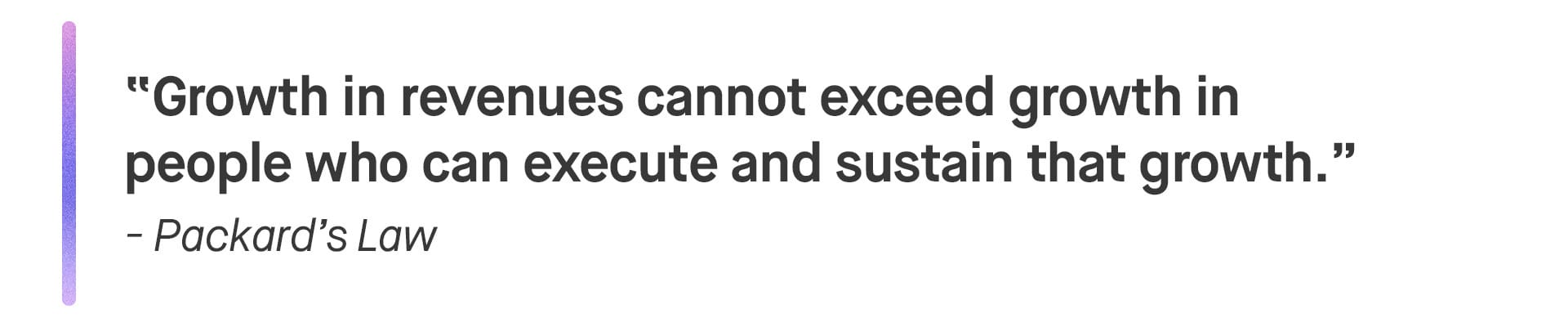
This is a problem because Packard’s Law suggests that if the scarce resource of crypto developers is not being redistributed to successful projects, crypto will struggle to grow.
Unproductive crypto projects hoard investment resources, too.
Crypto founders are notorious for over-raising from investors and living off the proceeds, with no market-imposed urgency to find product market-fit.
For example: One of the original crypto projects, Golem, stockpiled 820,000 ETH in its 2016 ICO, and still held 231,400 of it as recently as last year.
Traditional startup investors expect their capital to be deployed far quicker than that.
In other cases, projects with inexplicably large market valuations fund themselves seemingly forever by selling their native token out of treasury. Cardano, for example, holds roughly $700 million of its ADA token in treasury, which should keep the project funded approximately forever.
Collectively, crypto protocols are sitting on billions in capital and have little or no incentive to deploy it efficiently — no activist shareholders to placate, corporate raiders to fear or quarterly earnings estimates to meet.
In short, crypto may be too funded to fail.
Ben Thompson has recently articulated a similar fear about traditional tech, worrying that giants like TSMC, Nvidia and Alphabet have become so dominant that the entire ecosystem risks stagnation.
He therefore welcomes the bubble: “What is invigorating or why we should embrace the mania, embrace the bubble, is ‘too-big-to-fail’ was starting to afflict tech as well.”
Thompson notes that the benefit of private enterprise is that "stupid stuff" eventually goes out of business. But when companies become entrenched monopolies (or government-backed entities), the stupid stuff doesn’t die. It just becomes over-engineered and inefficient.
He argues we need investment bubbles precisely because they bring risk back into the equation: “You don’t get upside risk without downside risk.”
This might explain why crypto has felt so stagnant this cycle. We have the "stupid stuff" — protocols with few users and minimal revenue — but lack the mechanism to make them go out of business.
“Growth becomes difficult when everyone’s roots are tangled,” Lim warns.
Until a forest fire is allowed to burn through the tangled roots of over-funded zombie protocols, the nutrients — capital and developers — will remain trapped, and the next era of growth will remain out of reach.

Brought to you by:
Institutions and DeFi are converging on Canton, creating real-world finance with crypto-style speed.
The latest The Tie report shows growing demand for privacy, composability, and sustainable tokenomics.
With 575+ validators and 600K+ daily transactions driving on-chain activity, Canton’s network momentum is accelerating on-chain global finance.

Brought to you by:

Add onchain trading to your product without the hassle.
The Uniswap Trading API offers plug-and-play access to deep liquidity — powered by the same protocol that’s processed $3.3T+ in volume with zero hacks.
Get enterprise-grade execution across onchain and off-chain sources for optimal pricing. No complex integrations or crypto expertise — just seamless, scalable access to trusted DeFi infrastructure.
More liquidity. Less complexity.