- The Breakdown
- Posts
- 🟪 USDe’s Solana Growth Loop
🟪 USDe’s Solana Growth Loop
Plus, befuddled markets

Hello, accommodating readers! Byron is out this week, doing whatever Byron does when he’s not writing The Breakdown. Byron will be back next week for your regular scheduled programming.
This week, you’re getting a taste of our other Blockworks newsletter, 0xResearch. You’ll get daily alpha and insights from our Blockworks Research analysts.

Market Commentary
Markets seem befuddled by the Trump administration’s schizophrenic social media pronouncements on the Iran War, netting out to not much. The S&P 500 (+0.3%) and Nasdaq 100 (+0.2%) closed modestly higher Monday, with crypto-native sectors trading broadly in line. BTC finished -0.4% on the session, leaving the major beta indices clustered tightly around flat — L1s +0.2%, L2s -0.5%, Solana Ecosystem +0.4%, Ethereum Ecosystem +0.4%. A quiet tape, with the action concentrated in two idiosyncratic moves at the top of the leaderboard.

Modular (+4.3%) topped the cross-sector table, but the move looks idiosyncratic. DYM was the primary driver, and I wouldn't read this as a thematic signal for the modular thesis broadly.
DeFi (+3.1%) was another standout sector, driven almost entirely by Ondo. ONDO closed up roughly +11% on the day, breaking decisively away from the rest of the DeFi basket in the final four hours of trading (visible in the DeFi component chart).

The catalyst was SEC headlines on tokenization reported by Bloomberg, which Ondo could be uniquely positioned to capitalize on — the firm controls a substantial chunk of the tokenized equity market, has a no-action letter pending with the SEC since April, and is scheduled to begin production trades within the DTCC consortium in July alongside BlackRock and Goldman.
Other RWA-adjacent names participated more modestly — the broader RWA index was +1.0%, suggesting the move was a single-name re-rating rather than a sector-wide tokenization repricing. The Perps Index (+3.9%) and DEXs (+1.6%) rounded out the green, consistent with DeFi-adjacent strength rather than a directional crypto bid.

On the downside, Crypto Miners (-2.9%) and Bittensor Ecosystem (-2.5%) lagged, with AI (-1.0%), Exchange Tokens (-0.8%), and Buyback Leaders (-0.8%) also in the red. Miners diverging this hard from the broader Crypto Equities Index (+0.3%) is worth flagging, but I don't have a clean catalyst — could be Leopold Aschenbrenner FUD, as FinTwit pundits were reading too much into the March hedging behavior of Mr. “Ash burner.”
In sum, a relatively quiet day, punctuated by name-specific news (ONDO on tokenization, DYM on modular) rather than a directional bid or any clear thematic rotation.
— Macauley
USDe’s Solana Growth Loop
Ethena’s USDe growth campaign on Kamino and Jupiter Lend is proving how quickly Solana lending markets can scale new stablecoin products. As of May 18, roughly $530M is deposited into each market, for a combined $1.06B in deposits less than a week after launch.
Both markets enable users to loop USDG against USDe, with max yields currently around 20% and borrow capacity virtually maxed out. Ethena seeded both markets with roughly $200M of USDG liquidity, giving users immediate capacity to leverage the USDe carry trade.
The launch is also notable from a curation standpoint. Jupiter Lend’s market is being curated by Bitwise, likely the first example of an ETF issuer curating a DeFi lending vault, while Kamino’s market is curated by Sentora.
The early traction across both markets has been a tailwind for USDe supply growth on Solana, which has added roughly $560M since launch. Over the same period, USDG supply has fallen from $1.55B to $662M.

For now, demand appears constrained by USDG borrowing capacity rather than user appetite. We ran an hourly analysis on Kamino to better understand how the market has behaved.
Kamino case study
Our sample runs from May 12 at 19:00 UTC through May 18 at 18:00 UTC.
USDG supply was seeded at roughly $200M on May 12 at 19:00 UTC, but remained mostly idle until the public announcement on May 13 at 15:00 UTC. Demand appeared almost immediately: in that hourly bucket, USDG outstanding loans jumped from about $366K to $18.5M. By May 14 at 19:00 UTC, the reserve was near capacity.

Once the market became capacity-constrained, the next $50M of USDG liquidity on May 16 was absorbed far faster. USDG supply rose by about $50M at 12:00 UTC, and utilization was back near 100% by 13:00 UTC.
Overall, USDG utilization spent roughly 93 hourly observations above 99.9%, ending at 99.98% utilization with only about $46.3K of idle liquidity against roughly $250M supplied.
This has created very high gross leverage. Using USDG borrow divided by USDe deposits as a debt-to-collateral ratio, the market ended at 89.5%, implying roughly 9.6x aggregate leverage. The max observed ratio was 91.6% on May 13 at 18:00 UTC, implying roughly 11.9x aggregate leverage.
The market is effectively clearing on USDG borrow capacity. Demand to borrow against USDe collateral appears abundant, but the binding constraint is how much USDG can be borrowed. Once USDG utilization reaches 100%, new entrants cannot lever unless someone repays or new USDG capacity appears.
For Solana lending markets, this is a good early sign: liquidity showed up, users wanted to loop, and borrow capacity was filled almost immediately. But it is worth being clear about what is growing here. This is not broad, organic lending depth yet. It is highly efficient leverage formation around a specific stablecoin yield trade.
— Carlos
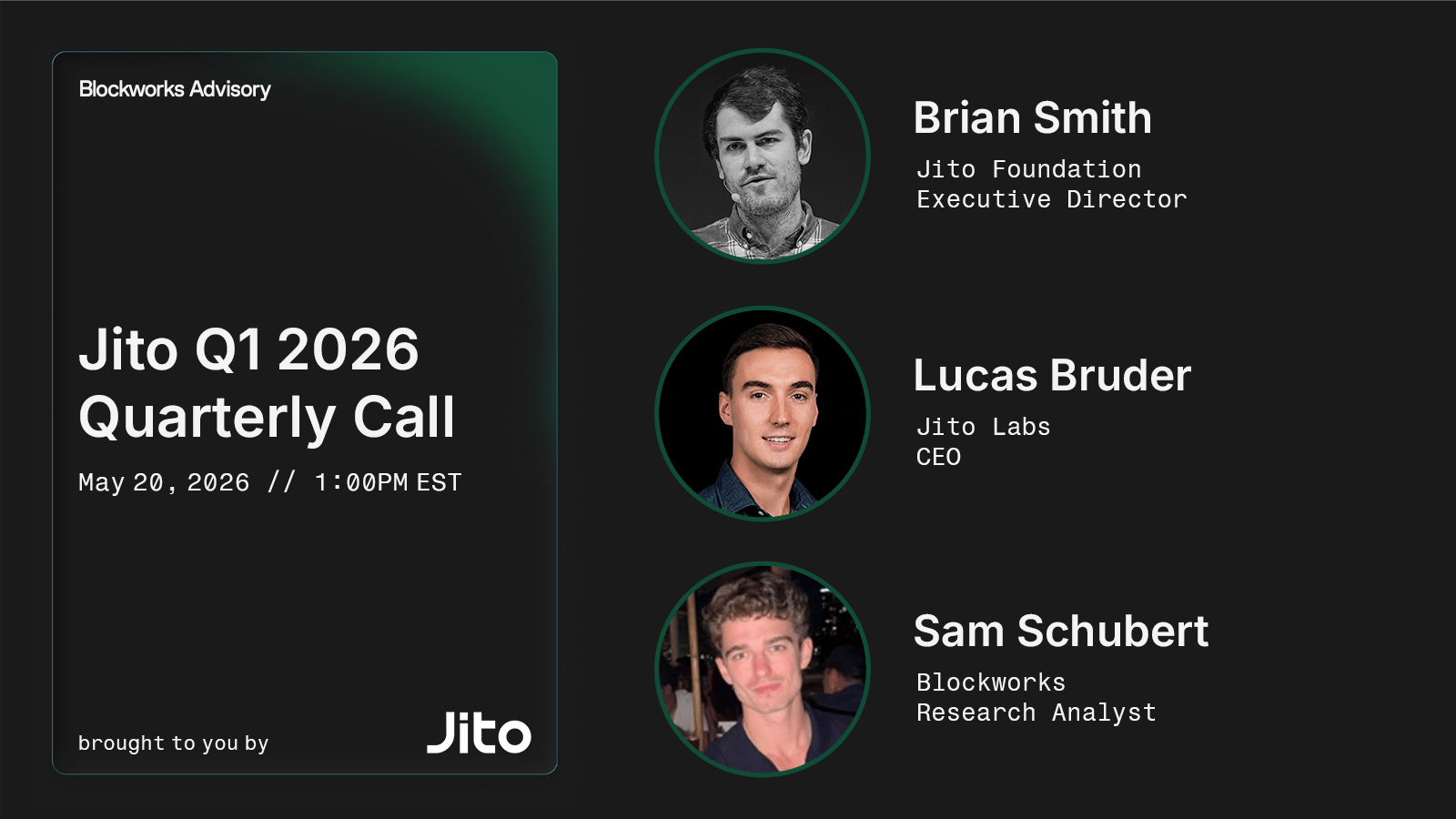
Q1 was a transformative quarter for Jito, marked by rapid validator adoption of BAM and growth in institutional distribution channels.
Join us in partnership with Jito for their official Q1 Quarterly Call, where we’ll break down the numbers, trends, and key takeaways from Q1 for one of crypto’s most influential protocols.
On Wednesday, May 20 at 1 pm ET, watch the call live from X, YouTube, LinkedIn or Blockworks.com.

